
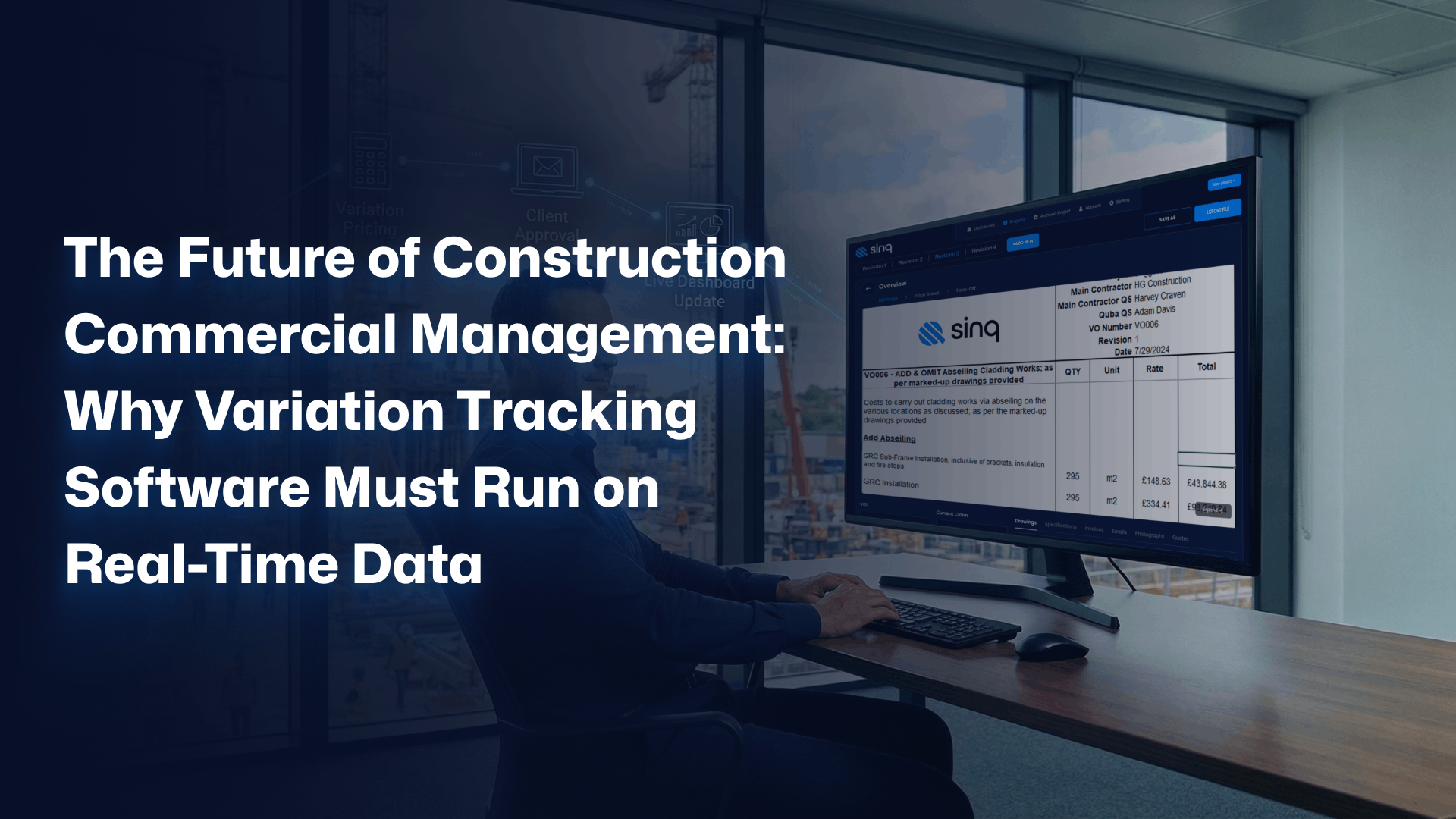
The variation log is in one spreadsheet. The subcontractor quotes are buried in inboxes. The client approvals live in PDFs that nobody can find when the dispute lands. Sinq sits in the middle of that chaos and quietly does the job those tools were never built for. This is where automation, AI and real-time data stop being buzzwords and start protecting your margin through serious Variation Software built for construction commercial teams.
When “We’ll Sort It At Valuation” Stops Working
You know the pattern. Site rings the QS about a change. Someone makes a note. A sketch goes over WhatsApp. The team plans to formalise it later. Then five more issues land before lunch.
For a while, this works. Until the client QS sends a variation schedule that looks nothing like yours and you are £120,000 apart.
The honest problem is not knowledge. Your team understands JCT and NEC. The problem is that your information lives in five places and none of them update in real time.
Automation is not about replacing people. It is about stopping senior commercial staff from acting as human middleware between site, email, spreadsheets and the final account.
Sinq’s real-time cost exposure dashboard pulls contract value, actual spend and every logged variation into one live view. As soon as a change is logged, the dashboard updates and shows the financial impact on margin. No manual refresh. No “I’ll update the spreadsheet later”.
We have seen projects where the cost report and site reality drift 20% apart before anyone notices. With Sinq’s cost exposure dashboard, that blind spot closes and the commercial director can act while there is still time to protect the job.
The internal system you are really running on
Most commercial teams are not “disorganised”. They are running on a structure that was fine at £1m jobs and is now creaking at £10m.
Here is what it usually looks like:
- A master variation spreadsheet that one person owns.
- PDF quotes saved into random job folders.
- WhatsApp threads where site instructions live and die.
- Email approvals from clients that are never collated.
It works. Until someone challenges the numbers.
Variation Tracking Software for Builders that simply recreates this mess on screen is pointless. You do not need another place to lose information. You need variation management software that acts as the system of record.
Sinq’s variation tracking logs every scope change in one place, with version control and financial values updated as you price. The audit trail logging feature timestamps every decision, comment and approval. No more “when did we agree that” at final account.
A commercial director at a regional contractor spent three days rebuilding a variation account for a dispute. With Sinq’s variation tracking and audit trail logging, that exercise becomes a 10 second export and the argument starts from facts, not memory.
Untracked Variations: Where Automation Finds The Money You Thought Was Gone
The money does not usually vanish in one big hit. It leaks out in small, unpriced changes that never quite make it into the formal account.
A door set swapped here. Extra fire stopping there. A weekend shift that “we’ll pick up later”. By practical completion, those fragments add up to a number that actually hurts.
Traditional Variation Order Software Construction tools often focus on forms and templates. Helpful, but not enough. The real risk is the gap between site activity and commercial visibility.
Sinq’s supervisor mobile RFI system closes that gap. Supervisors log site issues on their phones, attach photos and notes, and that record converts automatically into a variation in Sinq. The commercial team sees it instantly, prices it, and links any subcontractor quote directly to that variation through quotation management.
Not a week later. Now.
The financial cost of staying manual
On a £4.2m commercial refurbishment, we saw 14 unapproved changes buried in email threads by practical completion. The total exposure was £87,000. Not because the team did not know what they were doing. Because the system did not catch what they already knew.
Construction Change Software that does not surface live exposure is like running a site without updated drawings. Everyone keeps working, but nobody is sure what is actually current.
Sinq’s financial impact visualisation shows each variation against contract value and margin. Before work starts, you can see if the change keeps you whole or erodes profit. That is where AI starts to matter. It is not writing emails. It is highlighting which variations are commercially dangerous so you can push harder on approval or scope.
We have watched QS teams discover at month 9 that their “small” unpriced items total more than their entire target margin. Sinq’s financial impact visualisation would have flagged that trend in month 2 and given them a real chance to recover it.
Broken Approval Processes: Where Disputes Are Born
The most expensive words in construction are “yeah, crack on, we’ll sort it later”. Verbal instructions feel efficient on site. They are commercially lethal in a dispute.
Right now, many contractors run approvals through a mix of emailed PDFs, phone calls and the occasional signed form. Clients sit on documents. Approvals lag behind works. By the time anyone pushes, the job has moved on and you are arguing backwards.
Variation Approval Software that demands client logins usually dies on contact with reality. The client will not use it. So the team falls back to email and the audit trail collapses again.
Sinq’s structured client approval workflows solve this by removing all friction. The QS sends a secure email link from inside Sinq. The client clicks once to approve or reject. No login. No portal. The decision is timestamped automatically and locked into the audit trail logging.
You get a clear yes or no, with a date and time that will stand up in any final account discussion.
How automation changes the client conversation
Here is the truth. Clients are not always trying to shaft you. They are often just overwhelmed by documents and short of time. If approvals take effort, they get pushed down the list.
Construction Variation Approval Software that reduces the client’s task to a single click actually gets used. That is where automation earns its keep.
Sinq connects the approval directly to the variation record. The financial impact visualisation updates as soon as the client responds. Your real-time cost exposure dashboard reflects the new position instantly.
A supervisor logs a ground condition issue via mobile RFI. That triggers a variation in Sinq. The commercial team prices it, attaches the subcontractor quote, and sends the client a secure email link. The client approves from their phone. No WhatsApp. No “I never saw that”. No disputed invoice three months later. That is Sinq turning a chronic approval headache into a clean, defensible variation account.
Small Contractors, Big Risk: Why Size No Longer Protects You
Smaller main contractors often think serious automation and AI tools are for the tier ones. The reality is harsher. A £40k hole on a £1m job hurts more than a £400k hole on a £100m job.
Software for Small Contractors that only handles basic invoicing or timesheets misses the real commercial risk. Your exposure sits in variations, approvals and the gap between what site has done and what the client has agreed to pay for.
Manual systems rely on one or two key people holding the whole picture in their heads. When they are off sick, leave the business or just get buried in work, the system fails.
Sinq is built as Construction Variation Management Software that matches UK workflows, not just mega projects. Its variation tracking and quotation management features scale down as well as up. You log the change, drag and drop the PDF quote into the system, and Sinq reads the key numbers without manual data entry. Everything ties back to the variation and the contract.
Automation as a safety net, not a luxury
Let me be blunt. Hoping that “we are on top of it” is not a strategy. It is a bet. And the odds worsen with every extra instruction.
Site Variation Reporting Software that only generates forms does not solve this. You need a single source of truth that links site events, supplier quotes, client approvals and financial impact.
Sinq’s supervisor mobile RFI system means issues are recorded at the moment they occur. Its audit trail logging means those records cannot quietly disappear. Its direct PDF and Excel export means you can walk into any meeting with a variation schedule the client cannot easily dismiss.
On a £1.6m school extension, a small contractor we worked with had historically lost around 3% margin to under-documented changes. After moving to Sinq, their year-end review showed variation recovery up by £48,000 on a similar job value. Same team. Same client type. Different infrastructure.
What Automation, AI And Real-Time Data Actually Look Like Day To Day
A lot of tools talk about AI. Very few explain what it actually does for a QS on a wet Tuesday in Swindon.
You do not need a robot QS. You need something that watches the numbers, spots the drift and gives you the right information before the meeting, not after.
In Sinq, automation handles the grunt work. PDF subcontractor quotes drop into quotation management. The system extracts values and links them to the right variation. The real-time cost exposure dashboard updates automatically. The audit trail logging records every change without anyone having to remember to write it down.
AI supports the judgement calls. It highlights variations with high margin erosion. It flags when logged changes are not yet approved but work has started. It surfaces patterns in client approvals that tell you who is slow, who pushes hardest, and where to focus your energy.
A working day when the infrastructure is right
This is what a normal day can look like with Construction Variation Software at the core.
- 8:30am: Supervisor logs an access issue on site through the mobile RFI system. Sinq creates a new variation automatically.
- 9:15am: QS prices the variation, uploads the subcontractor quote to quotation management, and sees the financial impact visualisation show a 1.2% margin hit if unapproved.
- 9:30am: QS sends a secure approval link through Sinq’s Variation Approval Software. The client clicks approve before lunch.
- 1:00pm: The real-time cost exposure dashboard updates contract value, variations and projected final account. The commercial director sees the live position before the afternoon board call.
No manual spreadsheet updates. No chasing for “proof”. No late-night reconstruction before the valuation meeting. Just a company finally running on the structure it always needed.
A regional contractor’s commercial director told us they used to spend two days every month building a report that was already out of date when it hit the boardroom. With Sinq, their board pack pulls straight from live data and the meeting focuses on decisions, not data wrangling.
Why The Future Of Commercial Management Starts With Variations
The industry talks a lot about digital transformation. The reality on most jobs is still Excel, Outlook and hope. The next wave of commercial tools will not win because they look impressive in a demo. They will win because they stop margin bleeding out through untracked, unapproved and undefended changes.
Variation management software is where automation, AI and real-time data have the most immediate, measurable impact. Variations are where the job you priced becomes the job you actually deliver. If you do not control that interface, nothing else really matters.
Sinq sits exactly there. It connects site events, supplier quotes, client approvals and financial impact into one live, auditable system. It gives commercial leaders the visibility they need without burying their teams in extra admin.
Margin lost to untracked variations rarely comes back. Explore Sinq today and see how smarter variation management and live financial visibility protect your commercial position from first instruction to final account.