

Table of Contents
- What Is a Change Order Narrative (and Why Most Contractors Get It Wrong)
- What Owner Auditors Actually Look for in a Change Order Narrative
- The Anatomy of an Audit-Proof Change Order Narrative (Section by Section)
- 3 Real U.S. Change Order Narrative Examples (Annotated)
- How to Build the Evidentiary Chain Before You Write a Single Word
- Change Order Narrative Best Practices for U.S. Contractors
- Change Order Narrative Template (Plug-and-Play for U.S. Projects)
- Frequently Asked Questions About Change Order Narratives
- Write the Narrative Like an Auditor Will Read It Tomorrow
Picture this: you submitted a $214,000 change order six months ago. The owner just called. Not to approve it, but to audit it. Your project manager flips through the file and finds a two-sentence description that reads “additional foundation work due to site conditions.” That’s not a change order narrative. That’s a prayer. And auditors don’t grant prayers, they deny them.
The change order narrative is the single most underwritten document in U.S. construction. Contractors spend weeks pricing labor and materials to the last decimal, then dash off a paragraph that wouldn’t survive a five-minute review. The result: delayed payments, back-and-forth requests for information, and in the worst cases, complete denial of legitimate costs.
This guide gives you the structure, language, and real examples to write a change order narrative that stands up under any owner audit private, public, or federal. ant to make sure your next change order is audit-ready before the call comes? See how Sinq automatically links your photos, RFIs, and emails to every change order so your evidentiary chain builds itself.
What Is a Change Order Narrative (and Why Most Contractors Get It Wrong)
A change order narrative is the written justification document attached to a change order that explains the cause of the change, its scope impact, cost breakdown, and schedule effect in plain contractual language. It bridges the gap between what the numbers say and why those numbers are legitimate, and it is the primary document an owner’s auditor reads when deciding whether to approve or dispute a change order.
The difference between a change order form and a change order narrative
Most contractors confuse the two. Not the same document. The change order form, AIA G701, ConsensusDocs 795, or your owner’s proprietary form, is the instrument that modifies the contract price and schedule. It captures numbers. The change order narrative is the argument behind those numbers. It answers every “why” before an auditor can ask it.
Think of it this way: the form is the verdict. The narrative is the evidence presented to reach that verdict. Without strong evidence, no verdict holds. Most contractors hand the auditor a verdict with no case file behind it, then wonder why payment stalls for 90 days.
The best change order narratives read like a legal brief written by someone who was on the jobsite every day. They don’t guess. They don’t generalize. They cite the contract clause that was breached, the RFI that triggered awareness, the daily report that documented the impact, and the cost buildup that quantifies the damage.
Why the narrative is the document auditors actually read
Ask any owner’s representative what they scrutinize first. It’s not your cost breakdown spreadsheet. Auditors are trained to find the story: what happened, who directed it, when did you give notice, and does the cost add up to the scope described. The cost breakdown is evidence. The narrative is the story that makes the evidence credible.
Consider a $47,000 change order for unforeseen underground obstructions on a mid-rise parking structure in Denver. The cost backup was meticulous: labor hours, equipment standby time, concrete demo costs. The narrative said “additional excavation work.” The owner’s auditor reduced the CO by 38 percent because there was no description of what was encountered, no reference to contract Differing Site Conditions clause, and no daily report citations. The contractor had the receipts but not the story.
The two most common reasons change order narratives fail owner review
First: vague cause language. Phrases like “site conditions,” “owner-directed change,” or “design modification” tell an auditor nothing. They invite follow-up requests that delay payment by weeks.
Second: missing the contractual basis. Every change order must tie back to a contract clause that entitles you to compensation. Rather than writing what you did, you must first cite why you’re owed payment under the contract. Skipping this step is the single fastest way to trigger a dispute.
What Owner Auditors Actually Look for in a Change Order Narrative
Owner auditors — whether they work for a private developer, a state DOT, or a federal GSA contracting officer operate from a checklist whether they admit it or not. The checklist has four core questions, and every sentence in your narrative should answer at least one of them before the auditor thinks to ask.
The four questions every auditor asks when reviewing a CO narrative
- What triggered this change, and is it outside the original contract scope? The auditor needs to confirm this isn’t work the contractor was already obligated to perform.
- Did the contractor give proper notice? Most contracts require written notice within 7 to 21 days of discovering a change. If your narrative doesn’t reference your NOC date, the auditor assumes you didn’t give timely notice.
- Is the cost directly traceable to the triggering event? Every dollar claimed must connect to scope that wouldn’t have existed but for the change.
- Is the schedule impact real, or is it a grab for float? Auditors on public projects are trained to spot inflated delay claims that don’t trace to the critical path.
Red-flag language that triggers automatic scrutiny (and what to write instead)
Watch for these phrases in your own drafts. They send auditors straight to the dispute pile.
| Red-Flag Language | Audit-Proof Replacement |
| “Additional work as directed” | “Owner directed scope addition per Owner Representative email dated [date], referencing RFI #47” |
| “Unforeseen conditions” | “Differing Site Conditions Type I per Contract Section 4.3.1: subsurface rock encountered at elevation 892.4 MSL, 6.2 feet above boring log prediction” |
| “Design change” | “Architect-issued RFI Response #23 (dated [date]) modified structural detail S-4 from W10x49 to W12x58, increasing steel tonnage by 1.4 tons” |
| “Delay to completion” | “8 calendar days of critical path delay to Activity ID 1140 (Structural Steel Erection), consuming all available float and pushing substantial completion from [date] to [date]” |
How audit standards differ between private owners, public agencies, and federal contracts
Private owner audits focus on contract entitlement and cost reasonableness. They want to know if you followed the change order process and whether your price is market-rate. Public agency audits add a layer: they verify compliance with procurement regulations and may require certified cost data. Federal contracts particularly GSA, Army Corps, and DOT-funded projects trigger the Federal Acquisition Regulation (FAR) and require audit-ready cost or pricing data including labor rate certifications, material quotes, and subcontractor cost breakdowns. Your narrative must match the audit standard of the owner you’re working for.
The documentation chain auditors expect: NOC to RFI to daily reports to narrative
Not a suggestion. It’s the expected sequence. The Notice of Change (NOC) establishes that you flagged the issue while it was happening. The RFI links the design ambiguity or owner direction to the contractor’s awareness. The daily reports prove the cost was actually incurred on the dates claimed. The narrative ties all three together into a coherent argument. Miss any link in the chain and the auditor questions the entire claim.
To understand how rejection happens when this chain breaks down, review the 7 most expensive reasons change orders get rejected the patterns there map directly to narrative failures.
The Anatomy of an Audit-Proof Change Order Narrative (Section by Section)
An audit-proof change order narrative is not a wall of prose. It is a structured document with five distinct sections, each doing a specific job. Every section has a primary audience: an auditor who is skeptical by training and pressed for time. Write for that reader every time.
Section 1: Cause statement: framing the triggering event in contractual language
This is the most critical paragraph. Not because it’s long it shouldn’t be more than 3 to 4 sentences but because it establishes your legal basis for the change order. Cite the contract clause first. Then describe the triggering event in objective, observable terms. Then connect the two.
Example cause statement: “Pursuant to Contract Section 12.2 (Changes in the Work), the Owner’s Representative issued written direction on March 14, 2025 via email (reference: Owner Email Log #OE-031425) requiring the installation of a secondary HVAC distribution loop not shown on Contract Drawing M-3.2. This direction constitutes an Owner-directed scope addition beyond the original Contract scope of work.”
That is 57 words. It references the contract section, the direction type, the date, the evidence reference, and the scope boundary. An auditor can verify every claim in that paragraph within minutes.
Section 2: Scope impact: describing what changed and what did not
Auditors look for scope creep narratives — contractors who describe the changed work but quietly include adjacent scope that was always in the contract. Rather than listing everything you did, describe precisely what changed against the baseline contract and what you did not claim. That boundary statement protects you.
Use quantified language: linear feet, square feet, tons, cubic yards, labor hours. “Installation of approximately 340 linear feet of 4-inch schedule-40 PVC conduit, 12 junction boxes, and associated pull wire not included in original Electrical Contract Drawing E-7.1” is defensible. “Additional electrical work” is not.
Section 3: Cost justification: labor, material, and equipment breakdown language
The narrative section on cost doesn’t replace your cost backup spreadsheet. It narrates it. Summarize the key cost components in prose and reference the backup exhibit. State your labor source: “Electrician labor rates per current collective bargaining agreement, effective January 1, 2025, as documented in Exhibit C.” State your material source: “Material pricing per vendor quote from [Distributor Name], dated [date], attached as Exhibit D.”
Overhead and profit must also be justified. If your contract specifies a markup cap, cite the cap and confirm you’re within it. If it doesn’t, cite industry standard or your own cost accounting basis.
Section 4: Schedule impact: connecting the change to float consumption or critical path delay
Schedule impact is where most narratives fail completely. Evaluate this honestly: if the change consumed only total float and didn’t push the completion date, say so. An honest, modest schedule claim is far more credible than an inflated one. Auditors know when contractors are padding.
If you’re claiming delay, cite the specific activity IDs from your CPM schedule, the float consumed, and the revised completion date. “Activity 2240 (Exterior Masonry) had 4 days of total float prior to this change. The 9-day scope addition consumed all available float and imposed a net 5-calendar-day delay to the Contract Substantial Completion Date of [date].” That’s a defensible claim.
Section 5: Notice preservation statement: tying the narrative back to the NOC or RFI
Close every narrative with a notice confirmation. “Contractor provided timely written Notice of Change on [date] via letter [NOC-2025-017], within the 14-day notice period required by Contract Section 8.4. A copy of the NOC is attached as Exhibit A.” This single paragraph prevents the most common audit objection: that you failed to give notice and therefore waived your right to additional compensation.
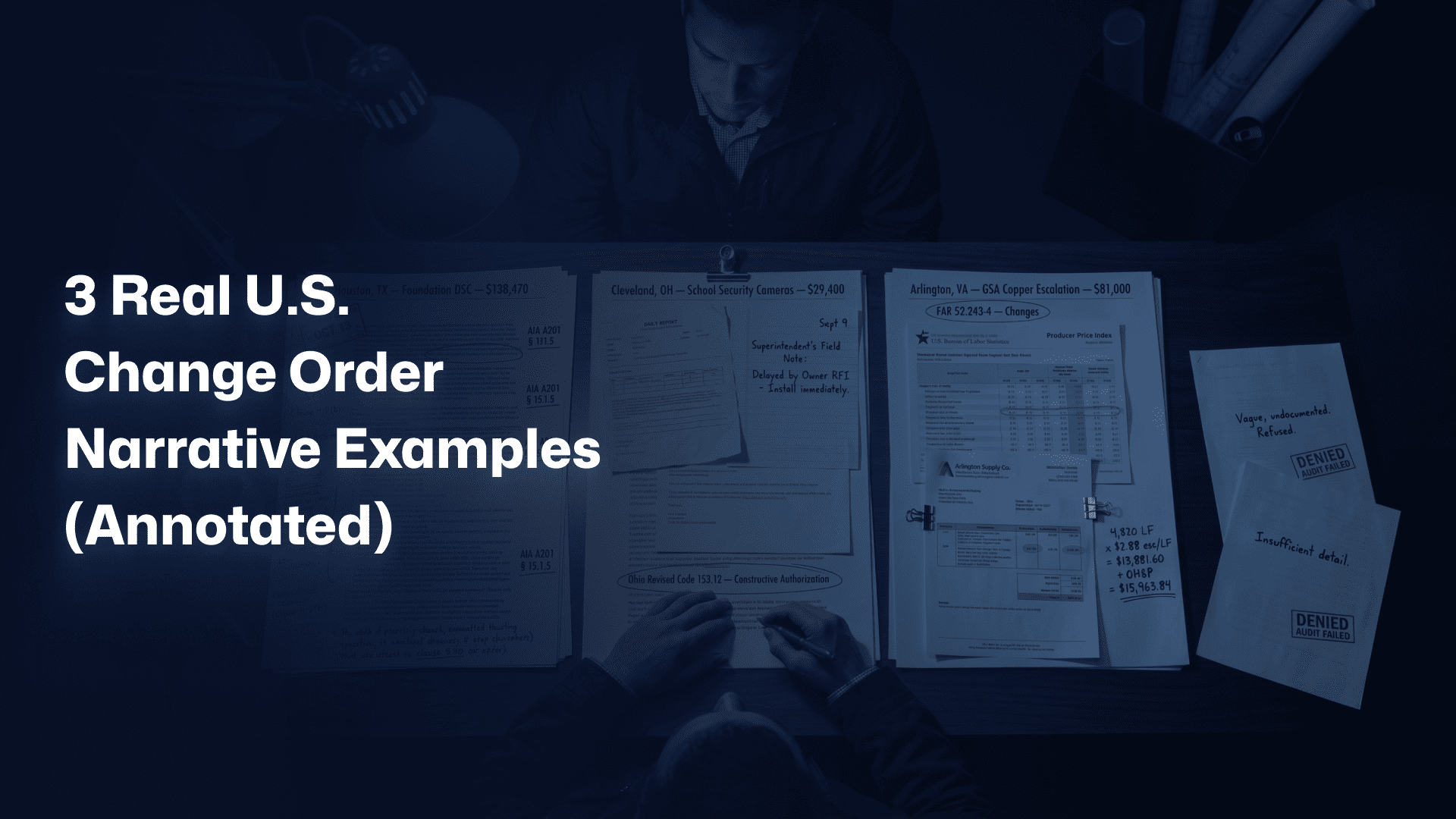
3 Real U.S. Change Order Narrative Examples (Annotated)
Real examples are more instructive than templates. The three scenarios below are composite reconstructions of genuine dispute patterns seen on U.S. projects. Each shows a weak narrative that triggered audit pushback, followed by an audit-proof rewrite, with annotation on why the revision works.
Example 1: Differing site conditions on a commercial foundation project (Houston, TX)
Context: A GC discovered expansive clay soil at 6 feet below grade on a tilt-up warehouse foundation project. The geotech report referenced sandy loam. The CO claim was $138,000 for additional excavation, soil import, and compaction.
Weak narrative:
“Encountered differing site conditions during foundation excavation. Soil was different from what was expected. Additional excavation and fill required. See attached cost breakdown.”
Audit-proof narrative rewrite:
“Pursuant to Contract Section 3.7.4 (Differing Site Conditions), Contractor encountered a Type I Differing Site Condition during mass excavation operations commencing April 3, 2025. Subsurface investigation report dated February 12, 2025 (Exhibit A) indicated sandy loam bearing soil with a bearing capacity of 2,500 psf at a depth of 6 feet below finished grade. Actual conditions encountered between elevations -5.8 and -9.2 feet below finished grade consisted of expansive Beaumont clay with a measured plasticity index of 52, a condition materially different from the geotechnical report’s prediction. Contractor issued Notice of Change NOC-2025-004 on April 4, 2025 (Exhibit B), within 24 hours of discovery and within the 7-day notice period required by Contract Section 8.1.
To achieve the specified bearing capacity, Contractor performed the following scope not included in the original Contract: removal and off-site disposal of 2,340 cubic yards of expansive clay (Unit Cost per Exhibit C), import and compaction of 2,180 cubic yards of engineered fill meeting ASTM D 698 standards, and geotechnical re-testing in accordance with specification Section 31 23 10. Total cost justification is supported by daily force account records (Exhibit D, Daily Reports DR-0403 through DR-0419), equipment time sheets (Exhibit E), and disposal manifests (Exhibit F). Net additional cost: $138,470. Net schedule impact: 12 calendar days of critical path delay to Activity 1050 (Foundation Slab Pour), as documented in Time Impact Analysis TIA-001 (Exhibit G).”
Why the rewrite works: It cites the specific contract clause, identifies the DSC type, quantifies the soil deviation with a plasticity index number, references every exhibit, confirms timely notice with a date, and separates out the added scope with precise quantities. An auditor can verify every factual claim without calling the GC once.
Example 2: Owner-directed scope addition on a public school renovation (Ohio)
Context: The principal of a Cleveland-area school verbally told the site superintendent to add security cameras to three additional corridors. No written change directive was issued. The work was performed. The CO claim was $29,400. The owner disputed it, claiming no direction was given.
Weak narrative:
“Owner requested additional security cameras in hallways. Work was performed as directed. Cost is as shown.”
Audit-proof narrative rewrite:
“On September 9, 2025, Principal [Name Redacted for Composite] of [School Name] verbally directed Superintendent James M. to install security camera mounting infrastructure in corridors C, D, and E, which were not included on Contract Drawing EL-11. Contractor’s site superintendent memorialized this direction in Daily Report DR-0909 (Exhibit A, dated September 9, 2025) and transmitted written confirmation to Owner Representative via email on September 10, 2025 (Exhibit B, Email Log OE-091025), requesting written authorization. No written authorization was received; however, Owner Representative did not dispute the scope addition in any written communication between September 10 and September 24, 2025, the date work commenced, constituting constructive authorization per Ohio Revised Code 153.12 and established Ohio public project precedent.
Contractor provided Notice of Change NOC-2025-011 on September 10, 2025 (Exhibit C). Scope added: installation of 9 camera mounting brackets, 760 linear feet of conduit, and rough-in junction boxes per camera locations marked in field sketch FS-0909 (Exhibit D). Labor and material costs are documented per force account records in Exhibits E and F. Total additional cost: $29,400. No schedule impact claimed.”
Why the rewrite works: It creates a paper record of a verbal direction by citing the daily report date and the follow-up email. It acknowledges the lack of a written change directive but invokes constructive authorization with a legal reference. It limits the claim honestly (no schedule impact), which adds credibility to the cost claim.
Example 3: Subcontractor material escalation on a federal GSA project (Virginia)
Context: A mechanical subcontractor on a GSA federal office building in Arlington experienced a 34 percent increase in copper piping prices between the bid date and material procurement, 18 months later. The prime submitted a REA (Request for Equitable Adjustment) on behalf of the sub. The claim was $81,000.
Weak narrative:
“Material costs increased significantly since bid. Copper prices went up 34%. Requesting additional compensation for price escalation.”
Audit-proof narrative rewrite:
“Prime Contractor hereby submits this Request for Equitable Adjustment (REA) pursuant to FAR 52.243-4 (Changes) and the Economic Price Adjustment clause (FAR 52.216-4) incorporated into Contract No. GS-11P-21-JC-C-0042, Section H, Paragraph H.7. Mechanical Subcontractor [Name] submitted a certified escalation claim to Prime on November 15, 2025, supported by Producer Price Index data (PPI Series WPU102501, Bureau of Labor Statistics) demonstrating a 34.2 percent increase in copper mill products between the bid date of May 3, 2024 and the material procurement date of November 1, 2025.
Material quantity affected: 4,820 linear feet of Type L copper pipe in diameters ranging from 0.75 inch to 3 inches, as specified in Mechanical Specification Section 22 11 16. Original subcontractor bid price per LF: $8.44 (Exhibit A, Subcontractor Bid Breakdown). Current market price per LF: $11.32 (Exhibit B, Distributor Quote #DQ-2025-1101, dated November 1, 2025). Net escalation cost: $81,178, calculated as (11.32 – 8.44) x 4,820 LF x 1.05 (sub overhead and profit per prime-sub agreement Section 9.3).
Prime contractor certifies that this REA is submitted in good faith, that the supporting data is accurate to the best of Prime’s knowledge, and that the adjustment requested is consistent with the contract price adjustment mechanism. Certification per FAR 33.207 is provided in Exhibit C.”
Why the rewrite works: It invokes the specific FAR clauses by number. It uses BLS PPI data a federal auditor’s preferred benchmark rather than anecdotal market claims. It shows the math transparently, attributes the markup to a contractual reference, and includes the FAR certification language that federal auditors require before processing any REA over $100,000.
For the pricing language behind cost buildups like Example 3, read the U.S. estimator’s pricing playbook for change orders, which covers direct cost markup methodology and defensible rate structures.
How to Build the Evidentiary Chain Before You Write a Single Word
The biggest mistake in change order narrative writing is starting with the narrative. Don’t. The narrative is the final step in an evidentiary assembly process that begins the moment a potential change is discovered on the jobsite. Writing the narrative first forces you to reconstruct events from memory and memory is not evidence.
Why the narrative is the last step, not the first
Ask yourself this before writing a single word: could I hand this file to an auditor right now and let it speak for itself? If the answer is no, you’re not ready to write the narrative. The narrative should be nothing more than a coherent summary of documents that already exist. If you’re creating facts in the narrative that aren’t in your project record, you’re not writing documentation you’re writing fiction.
Consider a contractor who submitted a $92,000 change order for accelerated work on a federal transit project in Phoenix. The narrative was detailed and well-written. But the auditor requested the daily reports that it cited. The daily reports didn’t mention overtime or the additional crew. The CO was denied in full, and the contractor faced questions about the narrative’s accuracy. Strong writing can’t save weak records.
How to use your RFI log as a narrative source document
Your RFI log is one of the most underused narrative sources in construction. Every RFI that resulted in a scope clarification, drawing revision, or specification change is a potential change order trigger. Cross-reference your RFI log against your change order log monthly. If an RFI response added scope and you don’t have a corresponding change order, you’re leaving money on the table.
When drafting the narrative, pull the original RFI number, the date submitted, the date answered, and the specific drawing or spec section modified. That sequence RFI submitted, RFI answered with scope change, scope change executed, cost incurred is the cleanest narrative structure available.
Linking daily reports and site photos to cost and schedule claims
Daily reports are your most credible cost evidence. They were written contemporaneously, by someone on the jobsite, before the change order was even contemplated. Auditors trust contemporaneous records over after-the-fact reconstructions every time. Train your superintendents to note in daily reports: any unanticipated work performed, any owner or architect direction received, any equipment standing by due to a change event, and any areas of work that could not proceed due to a pending change.
Site photos with dated metadata add a visual record to your cost claims. Rather than describing soil conditions in words alone, attach the photo taken on the day of discovery. Rather than narrating equipment standby, attach the photo showing the crane on a suspended lift. Photos don’t lie and auditors know it.
Notice of Change (NOC) language that protects your narrative downstream
The NOC is written at the moment of change discovery, not at the moment of narrative drafting. But the language in your NOC directly shapes what your narrative can claim. A vague NOC “we may incur additional costs due to site conditions” limits your narrative. A specific NOC “Contractor provides notice pursuant to Contract Section 8.1 that it has encountered subsurface conditions at grid lines D-7 through D-12 that differ materially from the geotech report, and anticipates additional cost and schedule impacts” opens the door to a full claim.
Write the NOC like it will be Exhibit A in arbitration. It might be.
Change Order Narrative Best Practices for U.S. Contractors
Change order narrative best practices are not about writing style. They’re about discipline: habits that a project team builds over months that make every individual narrative stronger and every audit less threatening. The contractors who survive audits cleanly are the ones who treat documentation as a daily discipline, not a billing-cycle scramble.
Always write to the contract, not to the relationship
This is the most uncomfortable truth in construction: the owner who “promised” to take care of you is not the owner who audits your change orders. Auditors don’t know about the handshake deal from the preconstruction meeting. They know what the contract says. Write every narrative as if the owner representative who directed the work has left the project and a skeptical auditor with no context is reading your document for the first time. Because that’s exactly what happens.
Rather than invoking relationship history, invoke contract language. Rather than saying “the owner agreed to cover this cost,” cite the contract clause and the written direction that authorized the work.
Quantify everything: the language of dollars, days, and percentages
Vague narratives are disputable narratives. Every claim in your narrative should be expressible as a number. Not “significant additional labor” 147 labor hours at a blended rate of $89.40 per hour. Not “delay to the project” 11 calendar days of critical path delay, consuming 8 days of total float and extending substantial completion from August 14 to August 25. Not “material price increase” a 21 percent increase in structural steel pricing between bid date and purchase order date, supported by CME futures data.
The best change order narrative writers are also the best cost engineers on the project. They understand the numbers well enough to narrate them, and they narrate them in terms an auditor can independently verify.
Maintaining a consistent narrative across the CO log, schedule updates, and pay applications
Inconsistency is the fastest way to create a dispute. If your change order narrative claims 11 days of delay, your schedule update must reflect 11 days of delay on the impacted activity. If your CO narrative claims $47,000 in additional labor, your pay application for the same period must reconcile with that labor expenditure. Auditors cross-reference these documents. A $47,000 labor claim in a CO narrative sitting alongside a pay application that shows the same crew on a different activity raises an immediate red flag.
Consistent change order documentation across the project record is also covered in the change order software playbook for U.S. contractors, which addresses how digital tools keep your CO log, schedule, and pay applications aligned automatically.
When to involve legal counsel before submitting a narrative
Honest concession: not every change order needs a legal review before submission. Small, routine scope additions on a cooperative private project can be submitted with a solid internal narrative and move through approval in days. The calculus changes when the amount exceeds your deductible, when the owner has indicated intent to dispute, when the change involves termination for convenience clauses, or when you’re on a federal project and invoking a REA. In those cases, submitting without counsel review is a false economy. A $2,500 attorney review of a $200,000 REA is the best insurance policy in construction.
Change Order Narrative Template (Plug-and-Play for U.S. Projects)
A change order narrative template gives you the structure. Your project record provides the substance. The worst thing you can do with a template is fill in the blanks and submit it without adapting the language to your specific contract, change event, and evidence base. Auditors have seen every generic template. What they haven’t seen — and what gets paid — is a narrative that sounds like it was written about this project, by someone who was there.
How to use this template without making it sound generic
Replace every bracketed placeholder with a specific citation. Every section should reference at least one exhibit by number. Every cost figure should appear in both the narrative and the backup spreadsheet. Every date should be verifiable against a project communication or daily report.
CHANGE ORDER NARRATIVE :TEMPLATE
Project: [Project Name] | Contract No.: [Contract Number] | CO No.: [CO Number] | Date: [Submission Date]
1. Cause Statement
Pursuant to Contract Section [X.X] ([Clause Title]), [triggering event: Owner direction / Differing Site Condition / Design Change / Force Majeure] occurred on [date]. [Describe the triggering event in one to two objective sentences referencing the specific contract scope it exceeded.] Contractor provided timely Notice of Change [NOC-XXXX] on [date], within the [N]-day notice period required by Contract Section [X.X] (Exhibit A).
2. Scope Impact
The following work was added to / deleted from the original Contract scope: [quantified scope description with drawing or spec references]. The following work was NOT affected and remains within the original Contract scope: [brief exclusion statement]. Total added scope is described in field sketch [FS-XXX] / RFI Response [#XX] attached as Exhibit B.
3. Cost Justification
Additional costs are broken down as follows: Labor — [hours] hours at [rate] per hour per [CBA / certified payroll / prevailing wage schedule] (Exhibit C). Material — [quantity] of [material] at [unit price] per [vendor quote / purchase order] dated [date] (Exhibit D). Equipment — [hours] hours of [equipment type] at [rate] per [rental agreement / owned equipment rate schedule] (Exhibit E). Subcontractor costs — [description] per subcontractor invoice [#] (Exhibit F). Overhead and profit applied at [N]% per Contract Section [X.X]. Total additional cost: $[Amount].
4. Schedule Impact
This change [impacted / did not impact] the Contract critical path. [If impacted: Activity [ID] ([Activity Name]) had [N] days of total float prior to this change. Execution of the added scope consumed [N] days of float and imposed a net [N]-calendar-day delay to the Contract Substantial Completion Date, revising it from [original date] to [revised date]. Time Impact Analysis TIA-[XXX] is attached as Exhibit G.]
5. Notice Preservation
Contractor confirms that all notice requirements under Contract Section [X.X] have been satisfied. NOC-[XXXX], dated [date], is attached as Exhibit A. Contractor reserves all rights to additional compensation and time extensions as may be supported by the project record.
Adapting the template for private, public, and federal contract types
Private contracts: emphasize entitlement language from the specific contract terms and keep the legal citations to the contract itself. Public state contracts: add reference to the applicable state prompt payment statute and the agency’s change order procedures manual. Federal contracts: add FAR clause citations, REA certification language per FAR 33.207, and Bureau of Labor Statistics data to support any cost escalation claims.
Variables to customize for subcontractor vs. prime contractor narratives
Subcontractor narratives must reference the prime-sub agreement rather than the prime contract with the owner. They should also include a pass-through notice: “Subcontractor provides this claim to Prime Contractor for pass-through to Owner pursuant to the flow-down provisions of Prime-Sub Agreement Section [X].” Prime contractor narratives submitted on behalf of subs must also include the prime’s own markup disclosure and a certification that the sub’s cost data has been reviewed.
Frequently Asked Questions About Change Order Narratives
These are the questions contractors ask most often when preparing change order documentation for owner review or dispute resolution. Each answer is designed to be used as a working reference during your own narrative drafting process.
What is a change order narrative in construction?
A change order narrative is the written justification document that explains why a change order is owed, what scope was added or removed, and how the cost and schedule impacts were calculated. It is attached to the change order form and serves as the primary document an owner’s auditor reads when evaluating a change order claim. It is not the cost breakdown spreadsheet — it is the argument that makes the spreadsheet credible. The best narratives cite contract clauses, reference dated project documents, quantify every claim, and confirm that notice was given on time.
How do you write a change order narrative for an owner audit?
Start by assembling your evidence: the Notice of Change, the RFI or owner direction, daily reports, and cost backup. Then write the narrative in five sections: cause statement, scope impact, cost justification, schedule impact, and notice preservation. Every claim must cite a specific exhibit. Every number must match your cost backup. Every date must be verifiable against a contemporaneous project record. Write to the contract, not to the relationship, and assume the auditor has no background on your project and no goodwill toward your claim.
What should a change order justification letter include?
A change order justification letter — sometimes used interchangeably with a change order narrative must include: the contract clause that entitles you to the change, a description of the triggering event with date and evidence reference, a quantified scope description, a cost breakdown with source citations for labor rates and material pricing, a schedule impact statement tied to CPM activity IDs, and a confirmation that timely notice was given with a reference to the NOC. For federal projects, add a REA certification statement per FAR 33.207.
How long should a change order narrative be?
Length should match complexity. A straightforward owner-directed scope addition on a private project might need only one page. A differing site conditions claim on a public project might require three to five pages plus exhibits. A federal REA for a complex acceleration or cardinal change claim might run 10 to 20 pages with a full cost proposal. The guiding principle: include everything the auditor needs to approve the claim without making a single phone call, and nothing that isn’t directly relevant to the claim. Padding a narrative doesn’t make it stronger — it makes it harder to audit and easier to dispute.
Can a change order be rejected after submission, and how does a strong narrative prevent that?
Yes. Change orders can be rejected at any point in the owner’s review process, including after initial approval if an audit later uncovers deficiencies. A strong narrative prevents rejection by pre-answering every question an auditor could raise. When the cause is clearly stated, the scope is precisely quantified, the costs are independently verifiable, the schedule impact is honest, and the notice is confirmed, there are no gaps for an auditor to fill with a dispute. Most rejections happen not because the work wasn’t done, but because the narrative didn’t prove it was owed.
Write the Narrative Like an Auditor Will Read It Tomorrow
Everything in this guide points to one discipline: build the evidentiary record first, then narrate what it says in the exact language of your contract. That’s the entire job. Contractors who do this consistently don’t dread owner audits — they invite them. Their change order documentation is so complete that an audit is just a formality rather than a fight.
The cost of a weak narrative is not just one rejected change order. It’s 60 days of disputed payment, a damaged relationship with the owner’s rep, and a precedent that every future CO on that project will face extra scrutiny. A strong narrative on CO #1 sets the tone for every CO that follows.
The contractors who get paid without disputes are not luckier. They’re more disciplined. They write the NOC the same day. They note the direction in the daily report that night. They link the RFI to the cost buildup before anyone asks. And when it’s time to write the narrative, they don’t start from scratch they summarize a project record that already tells the whole story.
Rather than scrambling to document changes after the fact, build the habit of contemporaneous documentation from the first day of the project. Rather than hoping the owner’s auditor will give you the benefit of the doubt, write a narrative that leaves no doubt to give.
Want to stop building the evidentiary chain manually? The right tool links your photos, RFIs, and emails to every change order automatically. See how Sinq attaches photo, RFI and email evidence to every change order and cut your audit prep time to zero.
Write it like an auditor reads it tomorrow because they might.