
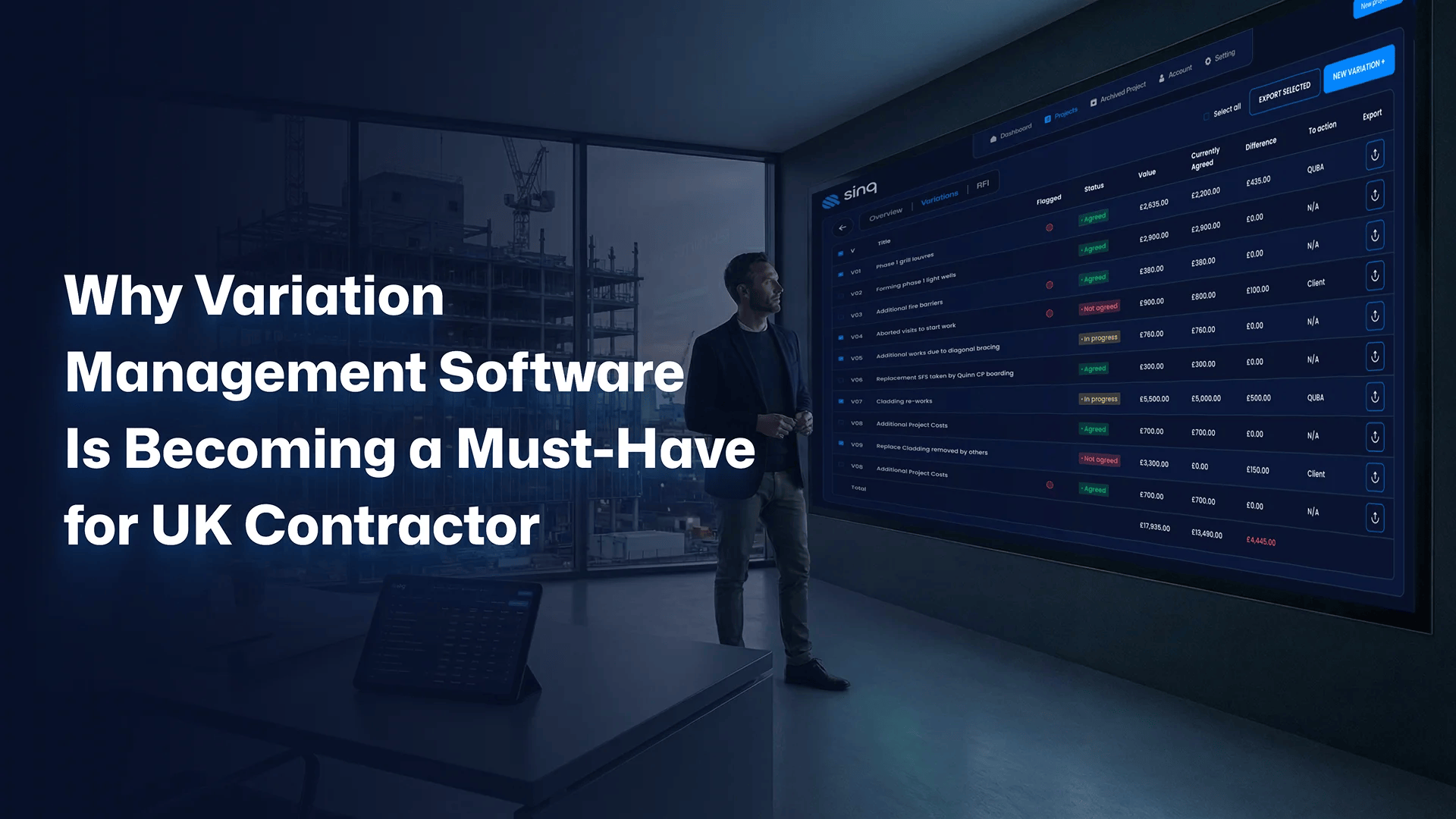
You don’t lose margin in one big dramatic moment. You lose it in a dozen quiet variations that never quite get priced, tracked, or approved properly. Sinq was built for that exact pain. Because once a client disputes a final account, it’s too late to wish you’d had proper Variation Tracking Software in place.
Let’s be blunt. Email threads, spreadsheets, and “I’ll sort it later” are not a variation process. They’re a liability. If you’re running multi-million pound jobs off half-documented scope changes, you’re gambling with your own profit.
The real problem with variations isn’t change – it’s chaos
You’re not scared of change on a project. You’re scared of the financial fog that follows it. Extra works get agreed verbally, drawings shift, a client walks the site and says “just move that wall” – and suddenly your cost report is fiction.
Variation Management Software is simply a structured way to capture every change, price it, approve it, and track its impact on margin. Ignore it, and you end up with:
- Work done without formal instruction
- Variations buried in WhatsApp or email
- Clients “surprised” by the final account value
Most contractors try to fix this with bigger spreadsheets and more meetings. They throw another QS at the problem and hope that “better discipline” will solve it. It rarely does.
The honest answer? You need the process baked into your tools.
Sinq’s variation tracking – from site trigger to client approval
Sinq’s variation tracking treats every scope change like a mini-contract. A variation is logged, given a value, linked to the relevant package, and version-controlled as it evolves.
Here’s how it works mechanically:
- A supervisor flags an issue via the supervisor mobile RFI system on the Flutter app
- That RFI becomes a variation candidate in Sinq, tied to a specific location and trade
- You upload subcontractor quotes directly against that variation using quotation management
- The variation is sent to the client via structured client approval workflows – a secure email link, no login needed
The client hits approve or reject. Sinq timestamps it, records who did what, and instantly updates your real-time cost exposure dashboard.
Managing variations on a spreadsheet is like building off outdated drawings – everyone thinks they’re right until the snag list explodes. We’ve seen projects where the cost report and site reality diverge by 20% before anyone notices. Sinq keeps those two worlds aligned so contractors get paid for the work they actually deliver.
When untracked variations quietly wreck your margin
The worst overspend isn’t the obvious one. It’s the slow drip of unapproved changes that look harmless in isolation but add up to six figures by final account.
Untracked variations are basically free work. You pay subcontractors, burn labour, and consume materials, but you never lock in the client’s financial commitment. That gap is where profit disappears.
Most teams try to fix this reactively. They scramble at month-end, trawling old emails, photos, and site diaries to reconstruct what happened. By then, the client has moved on mentally. They see a claim, not a fair adjustment.
Sinq flips that. It prices the risk before the work starts.
Sinq’s financial impact visualisation shows exactly how each variation affects contract value and margin. When you raise a variation, Sinq maps it against the live contract sum and actual spend. You see the margin exposure before you instruct the work.
Real-world examples of budget overruns – and how Sinq would have caught them
A main contractor on a £4.2m commercial refurbishment tried to reconcile variations at practical completion. They found multiple unapproved changes buried in email threads, worth tens of thousands of pounds. With Sinq’s real-time cost exposure dashboard, every one of those changes would have surfaced the moment it was logged, with clear values and status.
Another team had a client dispute a significant variation on M&E because “we never agreed that”. The QS spent days rebuilding the story from scattered emails. Sinq’s audit trail logging would have held every instruction, quote, approval, and timestamp in one place – exportable in seconds and ready to present.
Untracked variations are like hairline cracks in a slab. You don’t see the failure until it’s too late. Sinq gives you the early warning system, so contractors protect margin instead of apologising for it.
Why Sinq beats manual processes and generic Construction Change Software
You’ve probably tried some generic Construction Change Software already. Maybe it helps log changes, maybe it spits out a PDF, but it rarely speaks the language of UK main contractors actually running valuations and variations.
The pain isn’t “we can’t record changes”. The pain is:
- Client approvals drag for weeks with no visibility
- Subcontractor quotes arrive as messy PDFs with no link to the variation
- No one can answer “what’s our exposure today?” without a half-day in Excel
Most software for small contractors focuses on tasks, not money.
Sinq is different because it starts with the money and works backwards.
Real-time tracking features built for UK contractors
Sinq’s UK construction workflow alignment mirrors how you already work. Variations feed into valuations, contract changes, and final accounts the way your QS team expects.
Here’s what that looks like:
- Every variation sits in a structured register with status, value, and approval history
- Subcontractor quotes attach directly to the variation via quotation management
- Clients approve via Construction Variation Approval Software style workflows – they get a secure email, click through, and approve or reject in one action
No client login. No forgotten portal passwords.
For builders who need Variation tracking software that actually reflects site reality, Sinq keeps RFIs, quotes, approvals, and financial impact in one connected chain. That’s exactly why Sinq was built around variations first, not bolted on later like most Construction Change Software.
Audit trails, exports, and reporting you can stand behind
When a client challenges a variation, you don’t want a debate. You want evidence.
Sinq’s audit trail logging records every step of the variation lifecycle: who raised it, when, what changed, which quote was used, who approved, and at what value.
Then, with direct PDF and Excel export, you produce:
- Variation schedules grouped by status and client
- Cost summaries showing contract vs actual vs variations
- Evidence packs for specific disputed items
A supervisor logs a ground condition issue on their mobile RFI. That issue triggers a variation. That variation is quoted, reviewed, and approved by the client via secure email link – all inside Sinq. Every step is recorded and exportable.
The benefits of Sinq for main contractors: fewer fights, tighter forecasts
You don’t wake up wanting more software. You want fewer arguments with clients, fewer ugly surprises at month-end, and a cost report you can actually trust.
The biggest benefit of proper Variation Management Software isn’t admin efficiency. It’s predictability.
Sinq’s real-time cost exposure dashboard gives commercial teams a live view of:
- Original contract value
- Approved and pending variations
- Actual spend to date
That means you can push back early when a client’s expectations drift away from the budget. You’re not arguing from memory – you’re showing data.
Avoiding financial disputes with structured approvals
Disputes rarely start at final account. They start the day a variation is done without written approval because “we’ll sort the paperwork later”.
Sinq’s variation tracking and structured client approval workflows turn that risk into a controlled process. Each variation has a clear status: drafted, sent, approved, rejected.
Verbal approval means nothing in a dispute. A timestamped, system-recorded approval means you get paid.
Keeping projects financially predictable, even when scope moves
Scope creep isn’t going away. Clients will always tweak layouts, upgrade finishes, or compress programmes.
Sinq’s financial impact visualisation shows how each approved and pending variation shifts your projected margin. You see the cumulative effect, not just the line items.
Add in the real-time cost exposure dashboard, and your monthly cost meeting stops being guesswork. You walk in already knowing:
- Current projected final account
- Margin at risk from unapproved variations
- Packages running hot compared to original allowances
With Sinq, you see the financial impact of change while there’s still time to fix it.
Why variation management software is now non-negotiable
Variations are where you either protect your margin or give it away, and manual tools simply can’t keep up with the volume, speed, and scrutiny on UK projects. Sinq turns every change into a controlled, traceable, and financially visible event so contractors stay in charge of their profit instead of explaining it away.