
Subcontractor relationships do not break down over bad workmanship. They break down over missing evidence, disputed approvals, and no shared view of the variation numbers. Construction Variation Software exists to fix exactly that, and Sinq was built to stop those situations before they reach a dispute. By the time a subcontractor’s final account lands significantly above what the main contractor expected, the QS is trawling email threads and everyone is defending a different version of events. Furthermore, most variation disputes are avoidable when every change carries a clear record from the first site conversation to final approval.
When variations damage relationships with your supply chain and how Sinq’s variation tracking fixes it
Most tension with subcontractors does not come from one large disputed variation. It comes from dozens of small changes that nobody tracked cleanly, documented on WhatsApp, and then reconstructed in a spreadsheet weeks later. By the time the invoice arrives, memories have drifted and every party is defending their own version of events.
Most commercial teams try to fix this with more administration, more forms, more email templates, more colour-coded tabs in Excel that only one QS fully understands. However, that approach adds noise rather than clarity. The real answer is a single shared source of truth that records every variation from the first site conversation through to final approval.
Sinq’s Construction Variation Software does exactly that. Every scope change gets logged as its own variation record with value, description, attachments, and status. Furthermore, supervisors trigger it directly from the supervisor mobile RFI system on the mobile platform so the team captures every change at the point of discovery rather than three weeks later when context has gone cold.
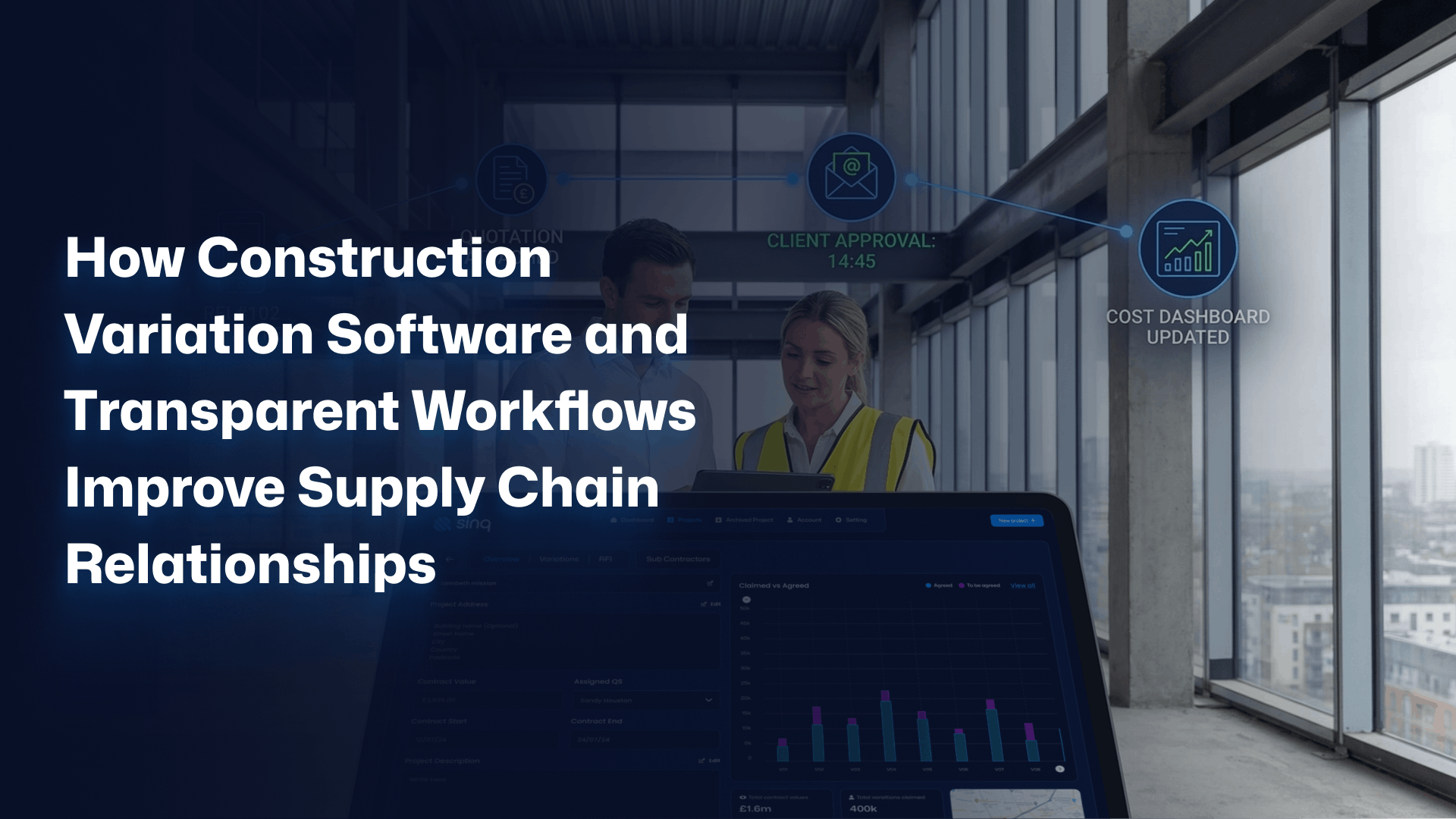
Once raised, that variation connects to quotation management where commercial teams upload subcontractor quotes as PDFs with zero manual re-keying. It connects to structured client approval workflows where Sinq emails the client a secure link and they approve or reject with one click, fully timestamped. As a result, the real-time cost exposure dashboard updates instantly to show the new variation value against contract value and actual spend so every party works from the same live financial picture. You can read more about how Sinq handles variation tracking across the full project lifecycle in our guide to variation accounts and margin protection and our Commercial Director’s guide to variation control.
How Sinq’s Site Variation Reporting Software keeps supply chain records accurate from day one
Variation records become shared evidence when every party can see the same information at the same time. Consequently, subcontractor conversations start from facts rather than competing recollections and the arguments, delays, and write-offs that drain commercial relationships reduce significantly.
Sinq’s Site Variation Reporting Software captures scope changes the moment they appear on site. Supervisors log the issue, attach photos, and tag the relevant trade directly in the platform. That entry reaches the commercial team instantly as a structured record rather than a scattered text message. Furthermore, Sinq connects every site instruction to a priced, approved, and timestamped variation record through its Variation Order Software Construction workflow. As a result, the chain from site discovery to commercial record never breaks and subcontractors always see a clear, accurate picture of what the main contractor has logged against their work.
The financial damage of untracked changes and how Sinq’s audit trail logging prevents it
Untracked or poorly documented changes produce three painful outcomes on every project. Subcontractors build risk into their rates on the next job because they do not trust the variation process. Clients question commercial competence when the main contractor cannot support variation claims with clear evidence. Furthermore, commercial teams waste days rebuilding a paper trail that should have existed from the moment the change appeared on site.
The common mistake is assuming the team can resolve everything at final account. Small changes accumulate in a mental backlog while the QS plans to reconcile them later. By the time the project reaches practical completion, half the evidence lives in someone’s phone, a site notebook, or a deleted email chain.
The fix is to give every change a number, a status, and a timestamp the moment it appears, not weeks later under dispute pressure.
Sinq’s audit trail logging does this automatically. Every change to a variation, raised, edited, quoted, approved, or rejected, gets recorded with user, date, and time attached. Nobody has to remember to type up the notes later because Sinq records every action in the background the moment it happens. The Chartered Institute of Building publishes guidance on variation documentation best practice that sits directly alongside what Sinq’s Construction Variation Software captures automatically on every project.
How Sinq’s financial impact visualisation shows margin risk before work proceeds
Layering financial impact visualisation on top of that audit trail gives commercial teams the full picture before they commit to a change. Each variation maps against the contract value and shows exactly how it shifts margin in real time. Furthermore, commercial teams stop agreeing to proceed with unpriced work because the financial consequence of every change is visible before approval rather than discovered at month end.
As a result, subcontractors and main contractors both work from a shared financial position that neither side can dispute because Sinq’s Construction Variation Approval Software records every decision with a timestamp and a named approver attached permanently.
How Sinq’s transparent Construction Variation Approval Software turns subcontractors into long-term partners
Main contractors do not want their best subcontractors treating every variation as an adversarial negotiation. However, when variation management runs on email, spreadsheets, and memory, subcontractors treat the main contractor as a financial risk. Consequently, they pad their quotes, chase constantly for updates, and argue at every valuation because they cannot see what the main contractor has logged against their work.
Most contractors try to fix this with more communication, more calls, more site meetings, and more follow-up emails. However, that approach creates noise rather than the clarity subcontractors actually need. Real trust comes from shared visibility into the same variation records.
Sinq’s Construction Variation Software gives that visibility without exposing the full commercial system to every subcontractor. Each subcontractor quote sits in quotation management, linked directly to the variation it relates to. When the commercial team reviews or adjusts a quote, Sinq versions it so the agreed price is always traceable. Furthermore, when the client approves through Variation Approval Software email workflows, that approval ties back to the same record so the full chain from subcontractor quote to client approval is always visible and connected.
As a result, “we thought you had approval” arguments stop because every party can see the exact status of every variation at any point in the project. The Royal Institution of Chartered Surveyors provides detailed guidance on subcontractor variation entitlement under UK contracts, which reinforces exactly why a shared, transparent variation record matters on every project.
How Sinq’s supervisor mobile RFI system captures changes where they actually happen
Most variation management software assumes variations start in the office. However, they start on site when a supervisor identifies an unexpected condition and the commercial team needs to know immediately. Consequently, tools that require office access or laptop login get bypassed entirely and supervisors fall back on photos and text messages that never reach the commercial record.
Sinq’s supervisor mobile RFI system lets supervisors capture issues exactly where they stand. A supervisor identifies unexpected services in a wall, opens the platform, raises an RFI, attaches photos, and flags that it requires a variation. That record reaches the office view immediately where the commercial team prices it, attaches subcontractor quotes via quotation management, and sends an approval link to the client.
Furthermore, there is no retyping, no lost context, and no gap in the record. As a result, the real-time cost exposure dashboard updates the moment the variation lands so commercial teams see the cumulative margin impact in real time rather than waiting for a monthly report to reveal the damage.
Why transparent variation workflows matter even more for smaller contractors using Sinq’s variation tracking software for builders
Smaller main contracting businesses feel every disputed variation more acutely than larger operations. Cash flow is tighter and one disputed final account can eliminate the profit from two well-run projects. Furthermore, many smaller firms treat proper variation management software as something only larger contractors need, so they continue with informal approvals and handshake agreements that collapse the moment a client pushes back.
Sinq is built around standard UK commercial processes so smaller firms get the same Construction Variation Approval Software discipline as larger operations without drowning in administration. Commercial teams still raise variations, attach quotes, and send approvals with one click. However, the system stays lean enough for a tight team to run without dedicated back-office support.
Sinq’s variation tracking software for builders means that when a client or subcontractor questions the numbers, the commercial team exports a clean variation schedule with values, approvals, and timestamps in seconds. As a result, smaller contractors walk into final account meetings backed by structured evidence rather than relying on memory and goodwill to recover money they have already earned. Build UK publishes industry guidance on fair payment and supply chain transparency that every smaller contractor should read alongside implementing Construction Variation Software on live projects.
Keeping projects commercially predictable with Sinq’s real-time cost exposure dashboard
Most construction change software options focus on logging the variation and then push the financial impact into a monthly report. By the time commercial teams see the damage, it is already embedded in the job and recovery options are limited. Consequently, profitable projects slide quietly into loss-making territory before anyone identifies the pattern.
Sinq’s financial impact visualisation changes that rhythm completely. As each variation gets raised, quoted, and approved, Sinq maps it against contract value and forecast margin instantly. Commercial teams see the exact point where a series of small extras turns into seriously exposed margin before the commitment is made.
Furthermore, the real-time cost exposure dashboard gives commercial managers a live financial position they can act on immediately. They can push back on scope creep, renegotiate with subcontractors, or re-sequence works while recovery is still possible. As a result, variation management shifts from a reactive end-of-month exercise into a daily commercial control process that protects margin across every project.
Getting started with transparent variation workflows in Sinq
The concern with any new variation tracking system is whether the team will actually use it consistently under site pressure. Sinq mirrors existing UK variation and valuation processes so commercial teams do not have to learn a new approach. They move their existing workflow into Sinq’s structured records and approval system without disruption.
Supervisors start raising RFIs in the platform. Commercial teams log variations against the contract. Clients approve via secure email links. Furthermore, Sinq’s direct PDF and Excel export means every existing client report and internal review feeds from live, accurate data rather than manually assembled spreadsheets.
As a result, within one valuation cycle most commercial teams make the shift from scattered evidence to a single auditable chain that every party trusts.
Transparent variation workflows as the foundation of stronger supply chain relationships
Transparent variation workflows do not just protect margin. They change how subcontractors and clients trust the main contractor to manage change fairly. With Sinq’s Construction Variation Software, every variation moves through a visible, auditable path that turns potential conflict into a collaborative, evidence-based process.
Ready to take control of your construction finances? Explore Sinq today and see how smarter variation management starts on day one.