
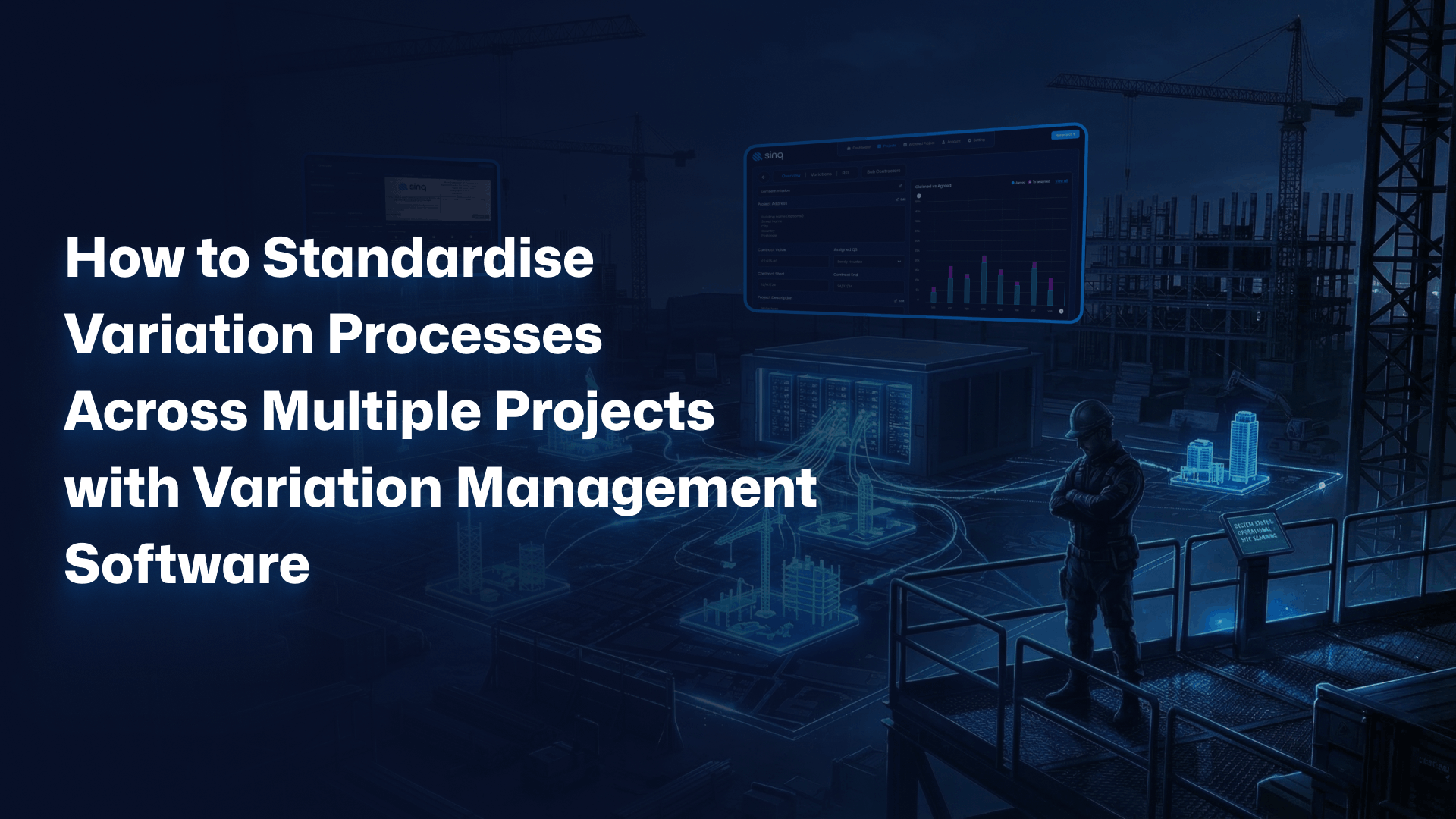
The variation log on Project A lives in a spreadsheet. Project B uses a different template. Project C has nothing formal at all, just emails and a “running list” in someone’s notebook. Sinq was built for exactly this kind of quiet commercial chaos. You are not short of hard work or experience. You are short of one way of working that every site actually follows.
Right now, every project team swears their numbers are right. Until you put the three variation accounts next to each other and realise the same client instruction appears three different ways, with three different values. That is not a competence problem. It is a systems problem. Variation Management Software only matters if it fixes that, day one.
When every project runs its own variation process, margin disappears
You already know the pattern. One project uses a detailed variation form, another relies on the QS to “pick it up at valuation”, and the third trusts WhatsApp and memory. The client sees three completely different standards from the same contractor.
Managing variations like this is like trying to pour concrete from three mixers into one foundation with no shared pour plan. It looks busy. It does not set level.
The financial damage shows up here:
– Variations started on site before pricing
– Verbal approvals that never make it into a formal record
– Different spreadsheets per project, none reconciled to the same structure
Most contractors respond by tightening “process discipline”. More emails. More forms. Another version of a variation log. It works for a month. Then the next job starts, a new PM joins, and the old habits creep back in.
The real fix is one standard variation flow that every project follows because the system makes it the easiest thing to do. Not a PDF template. A single Variation Management Software layer that sits across all jobs.
Sinq’s variation tracking feature does that mechanically. Every scope change is logged in one central system, tagged to a project, cost code and client package. Version control is automatic, so when a QS updates the value or description, Sinq records the change, timestamps it and updates the live cost exposure.
The real-time cost exposure dashboard then pulls contract value, actual spend and logged variations from every site into one view. You see the same structure for a £500k fit out as for a £15m new build. No custom spreadsheets. No project-by-project improvisation.
We have seen mid-size contractors running multiple live projects where the “master” variation log was a different Excel file for each job. Once they moved to Sinq’s variation tracking and cost exposure dashboard, the commercial director could sit down on a Friday and see a standardised variation account for all projects in under 30 seconds.
What your internal system actually looks like now
Here is the honest picture for most commercial teams:
– A master variation spreadsheet that one QS “owns”
– Site instructions recorded in WhatsApp, email and photos
– Subcontractor quotes saved as PDFs in random project folders
– Client approvals buried in email chains, sometimes with no clear “yes” at all
It works. Until it doesn’t.
The problem is not that people do not care. It is that the infrastructure does not match the commercial risk. On one project, the PM is disciplined and logs everything. On the next, they are firefighting daily and the paperwork follows weeks later, if at all.
Sinq standardises the flow without asking your team to become administrators. The supervisor mobile RFI system lets site teams log issues in real time from their phone. That RFI automatically converts into a draft variation in Sinq, already linked to the right project and package.
A QS in the office sees that draft, prices it, and attaches any subcontractor quote directly to the same record using the quotation management feature. They upload the PDF, Sinq reads the figures, and links them to the variation without manual retyping.
Untracked variations across multiple sites quietly rewrite your final account
You rarely feel the cost of a missed variation in the week it happens. The labour is already on site. The plant is already hired. The supervisor does what they have to do to keep the programme moving.
The real impact arrives months later, when the client’s QS sends their variation schedule and it bears little resemblance to yours. Different descriptions. Different quantities. Some items missing entirely. Across three or four projects, that gap is not theoretical. It is six figures.
On a £4.2m commercial refurbishment, we saw unapproved changes buried in email threads by practical completion. The contractor recovered just over half. The rest was written off as “lessons learned”.
The common response is to do a reconstruction at the end:
– Dig through emails for any mention of scope change
– Ask supervisors to “remember” when and what was agreed
– Rebuild a variation log from scratch days before the final account meeting
By that point, your negotiating position is already weak. The paper trail does not exist.
Sinq tackles this at the point of change, not months later. The supervisor mobile RFI system captures the issue from the site the moment it appears. That record is timestamped and geotagged. It becomes a variation in Sinq automatically, with a clear link from site photo to cost item.
The financial impact visualisation then shows that variation against the live contract value and margin. Before you send anything to the client, you already see what this change does to your job’s profit.
Sinq’s audit trail logging keeps every decision around that variation in one place. Who priced it, when the PM reviewed it, when the client approved or rejected it, and any subsequent re-price. In a dispute, you export a timestamped history.
We have watched projects where the cost report and site reality diverged significantly before anyone noticed. Sinq’s real-time cost exposure dashboard would have shown that gap as it formed, with logged variations clearly outpacing approved ones.
The quiet cost of inconsistent approvals
Approvals are where most variation accounts fall apart. One client expects formal variation orders. Another is happy with a quick email reply. A third gives verbal agreement on site and “will sort the paperwork later”.
Across multiple projects, your team ends up running different approval standards. The risk is simple. The client chooses the strictest standard at final account, not the loosest one you have been working to.
Sinq’s structured client approval workflows give you one standard, every time. From inside the variation record, the QS triggers an approval request. Sinq sends the client a secure email link. They click it, see the description, value and supporting documents, then hit approve or reject. No login. No portal training.
That decision is timestamped automatically and written into the audit trail. If they change their mind months later, you have the original approval with date and time. If they ignore the email, Sinq shows the request as pending, so your team knows what to chase.
Standardising reporting so every project speaks the same financial language
The monthly headache is familiar. You pull together a commercial report for the board and spend days reconciling numbers from different project teams. Each job has its own variation categories, its own naming conventions and its own idea of what is “approved”.
The financial risk is not just missed revenue. It is bad decisions based on unreliable data. If your live exposure is wrong by even a few per cent across a portfolio, you are making resourcing and bidding decisions on fiction.
Most contractors try to fix this with a “group template”. A standard Excel sheet everyone is supposed to use. It lasts until the first project that needs a tweak, then someone adds an extra column, another person deletes a tab, and your standard is gone.
Sinq creates that standard at system level, not template level. The variation tracking feature uses consistent fields across every project. You configure it once to match your JCT or NEC processes, then every project inherits it.
The real-time cost exposure dashboard then rolls those standardised variations into a portfolio view. You see original contract value, approved and pending variations, rejected items and forecast final account for every job, in the same format.
Sinq’s direct PDF and Excel export then lets you pull that data out in one click. You can send a variation schedule to a client, a board report to directors or a subcontractor reconciliation to your supply chain, all from the same underlying dataset.
Turning messy site instructions into defensible, approved variations
The real challenge is not the variation form. It is the moment on site when something changes and nobody has time for a form at all.
Ground conditions differ from the survey. The client’s rep asks for an extra door. An existing wall is found to be unsound. The supervisor phones the PM, gets a quick “crack on” and the work starts. The paperwork will catch up later. Sometimes it never does.
Construction Change Software that lives only in the office cannot fix that. The process has already bypassed it.
Sinq starts at site level. The supervisor mobile RFI system lets supervisors snap a photo, add a short description and flag an issue while they are standing in front of it. That RFI is instantly visible to the QS and PM in Sinq.
From there, the QS converts it into a variation with one click. They assign a value, attach any subcontractor quote using the quotation management feature and set the status to “For Approval”. Sinq then sends the structured client approval email.
This replaces several disconnected steps:
– No separate email to the QS
– No manual copy-paste into Excel
– No waiting for the PM to remember to raise a variation order
Once approved, that variation feeds straight into the real-time cost exposure dashboard and financial impact visualisation. The commercial director sees, in near real time, that the project has just picked up instructed work and what margin it carries.
Why standardising variation processes now protects every future project
Standardising variation control across multiple projects is not a “nice to have” tidy up. It is a direct defence of your margin, your cash flow and your reputation as a main contractor who actually knows their numbers.
Sinq gives you one variation process, one approval standard and one live cost picture across every job, from small works to major projects. Margin lost to untracked variations rarely comes back. Explore Sinq today and see how smarter variation management and live financial visibility protect your commercial position from first instruction to final account.