
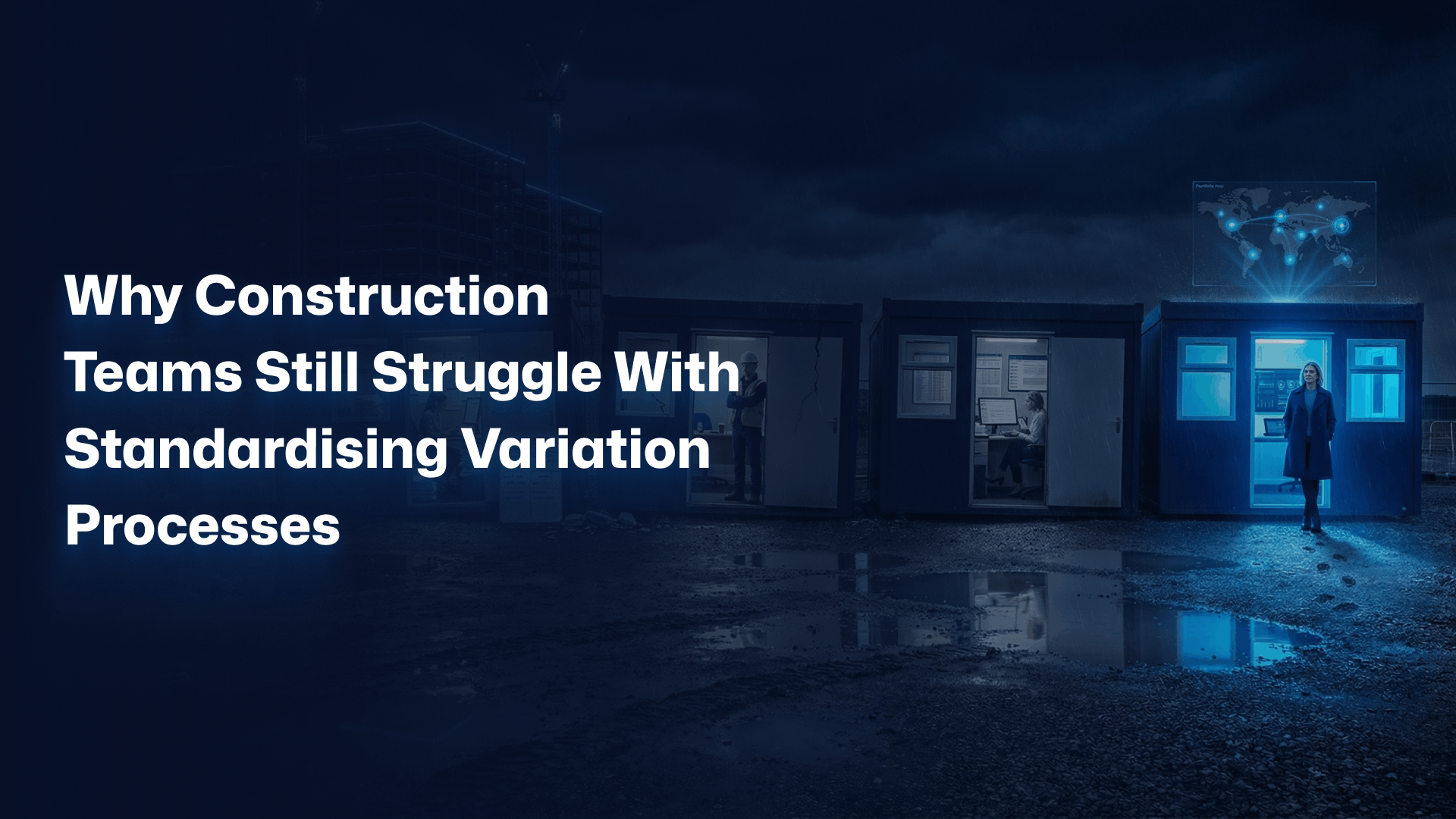
You’ve tried this before. You wrote the procedure. You shared the template. You told the team how variations should be raised, approved, and tracked. For a few weeks, maybe a month, things looked different. Then a project got busy, a subcontractor pushed a variation through the old way, a QS reverted to the spreadsheet they knew, and the standard quietly dissolved back into individual habit.
Twelve months later, you have four live projects running four different variation processes. One QS manages variations through a bespoke tracker. Another relies on email chains with a loose naming convention. The site manager on your largest contract raises variations by phone and follows up when he remembers. Your commercial director can’t produce a consistent variation register across the portfolio without spending an afternoon collecting information from three different systems and two people who weren’t in last week.
This is the variation process problem on UK construction projects that nobody talks about as a strategic failure because it doesn’t feel like one failure. It feels like a hundred small ones, each one explainable, each one reasonable in context. The project was under pressure. The client wanted a fast answer. The old way was quicker this once. The standard slips not through negligence but through friction: a process that requires extra effort from already-stretched teams will lose to the path of least resistance every single time.
According to RICS research on commercial management in UK construction, inconsistent variation management is one of the top three causes of margin erosion on projects above £500,000 in value. The money doesn’t vanish in a single dispute. It disappears across dozens of variations that were managed just well enough to proceed and not well enough to defend.
Variation tracking software for builders and construction variation approval software exists to solve exactly this problem not by adding a process that teams need to follow, but by making the right process the only available path. The distinction matters more than most people realise when they first look at construction technology.
The Cultural Barrier: Why Construction Teams Resist Process Change
Construction has a well-earned reputation for getting things done through relationships, experience, and professional judgement rather than formal systems. That culture built the industry. It also makes standardisation genuinely difficult in ways that process consultants and software vendors consistently underestimate.
The resistance isn’t laziness. Site managers and QSs who’ve been working in construction for fifteen years have variation processes that work: not perfectly, not consistently, but well enough that they’ve survived the projects they’ve been on so far. When you ask them to change, you’re not asking them to fix something they experience as broken. You’re asking them to invest time in a new system whose benefits they won’t see until final account, months from now, on a project that hasn’t gone wrong yet.
That is a hard sell at 7am on a live site.
The best teams that have cracked variation process standardisation in UK construction didn’t win by enforcing compliance. They won by reducing the friction of the correct process until it was easier than the incorrect one. Rather than making people choose between the standard and the fast route, they made the standard the fast route. A site manager who can raise a Variation Request Form with three photographs on their phone in under two minutes isn’t being asked to do more work. They’re being given a faster way to do the same work with a better output.
Not a policy. A tool.
The Operational Barrier: Every Project Has a Different Client, Contract, and QS
Even contractors who genuinely want to standardise their construction variation workflow management run into a structural problem: no two projects are the same, and variation management requirements vary meaningfully between them.
A JCT contract treats variations differently from an NEC contract. A public sector client has different notification requirements from a private developer. A project with a novated design team has a different approval chain from one where the client retains design authority. The QS on Project A has ten years of experience managing complex variation portfolios; the QS on Project B was promoted eighteen months ago and is still developing their commercial instincts.
Each of these differences creates a genuine argument against a one-size-fits-all standard: “our process has to flex to the contract.” And that argument is not wrong. It just gets used to justify far more variation in practice than the contractual differences actually require.
Consider what genuinely varies between projects and what doesn’t. The contractual notification periods, the required approval authorities, and the specific valuation mechanisms do vary. The underlying process requirements don’t: a variation needs to be identified and recorded at the point of instruction, described with enough precision to define scope, approved through a chain that creates a defensible record, costed against the contract value, and communicated to the relevant parties in time. Those five things are constant across JCT, NEC, FIDIC, and every bespoke building contract used in UK construction.
The best variation approval system for builders handles this by separating what’s configurable from what’s fixed. Contract type, notification periods, approval authorities, and project-specific fields are configurable per project. The underlying capture, approval, and audit trail workflow is consistent across the entire portfolio. The QS on every project follows the same fundamental process. The specific parameters change to match the contract.
That is standardisation that survives contact with reality.
The Contractual Barrier: When the Contract Creates Ambiguity Rather Than Clarity
Some of the most persistent variation process problems on UK construction projects aren’t cultural or operational. They’re contractual: situations where the contract itself is ambiguous about what constitutes a variation, who has authority to instruct one, and what the notification requirements actually are.
NEC contracts, for example, are built around a compensation event mechanism that requires precise notification within defined timescales. Get the notification wrong late, to the wrong party, or using the wrong clause reference and the entitlement lapses regardless of whether the work was genuinely instructed. The process isn’t just commercially important. It’s contractually critical.
JCT contracts create a different problem. The definition of what constitutes a variation is broad enough to generate genuine disputes about whether a particular instruction falls within the original scope or creates a new entitlement. Contractors who haven’t documented the instruction precisely, including what was requested, why it differs from the contract documents, and what the commercial impact is, find themselves arguing position rather than fact when the client’s QS reviews the variation register.
Picture a mid-sized main contractor running eight projects simultaneously, four on JCT and four on NEC. Without a consistent construction change control standardisation process, the NEC projects are managed by QSs who know the compensation event mechanism well, and the JCT projects are managed by QSs who handle variations more loosely, because JCT is more familiar and seems more forgiving. At final account on the JCT projects, three variations worth a combined £67,000 are challenged on scope grounds. The documentation that would have closed those challenges contemporaneous descriptions, photographs, signed instructions was never consistently captured because nobody told the QS it was equally important on JCT as on NEC.
The loss isn’t contractual. It’s process.
The Technology Barrier: Why Generic Tools Don’t Create Construction-Specific Standards
Most UK contractors have tried to standardise variation management using tools that weren’t built for it. Shared drives with template forms. Spreadsheet trackers distributed at project start and diverging within weeks. Generic project management platforms where variations sit alongside RFIs, drawings, and meeting minutes with no dedicated workflow.
These tools share one fundamental problem: they require the user to impose structure rather than providing it. A shared folder with a template form does not prevent someone from creating a new form, using a different naming convention, or filing the completed form in the wrong location. A spreadsheet tracker does not enforce who needs to approve before costs are committed. A generic project management platform does not distinguish between a variation that has been formally approved and one that has been informally discussed and is sitting in a notification thread.
The result is a process that is standardised in intention and inconsistent in execution. The template exists. The standard doesn’t.
The right construction variation approval software inverts this relationship. Rather than giving teams a form and hoping they use it correctly, the platform provides a workflow: variation raised, evidence attached, approval routed to the correct party, cost committed only after approval received, notification issued to relevant stakeholders automatically. The team doesn’t need to remember to follow the process. The process is the system.
Ask yourself what would happen if your three most experienced QSs left tomorrow and were replaced by people half their experience level. Would your variation management process hold? If the answer is “probably not,” then your process lives in people rather than in a system. That is a commercial vulnerability with a date on it.
The Visibility Barrier: Standardisation You Can’t Monitor Doesn’t Hold
A variation process can be perfectly designed and completely invisible to the people responsible for it. That is another way of saying it doesn’t exist.
One of the most consistent failure patterns in consistent variation process management for UK contractors is the absence of portfolio-level visibility. The commercial director knows what each QS has told them. They don’t know whether what each QS has told them is accurate, complete, or current. There’s no dashboard showing which projects have outstanding variation approvals, which have cost exposure approaching the contingency limit, and which have variations that were raised but never formally approved.
Without that visibility, the commercial director manages through exception: they find out about problems when someone escalates them, rather than monitoring the process in real time and catching issues before they become disputes.
How to create a consistent variation management process across UK construction projects starts with this question: can the person responsible for commercial oversight see the variation status across every live project from a single view, updated in real time, without asking anyone for a report?
If the answer is no, the process isn’t standardised. It’s delegated.
The best variation tracking software for builders in the UK solves this with a real-time cost exposure dashboard: every project, every variation, current status, current cost exposure against contract value, outstanding approvals, and time-impacted variations flagged for attention. The commercial director doesn’t need a weekly call to understand the portfolio’s commercial position. They have it constantly, which means they can intervene early rather than manage consequences.
Why Standardisation Efforts Fail at the Project Level (And What Actually Works)
The standard playbook for variation process improvement in UK construction follows a recognisable pattern. The commercial director identifies the problem. A working group produces a procedure document. The document is circulated at a company-wide meeting. Project teams are asked to adopt the new process from the start of their next project. Three months later, a project audit reveals widespread non-compliance, and the procedure is either enforced through management pressure or quietly abandoned.
This pattern fails for a reason that the working group almost never addresses: the procedure asks teams to change their behaviour without changing the system that makes the old behaviour easier than the new one.
Behavioural standardisation is fragile. Systems standardisation is durable. The difference is not about compliance or culture or buy-in. It is about friction: which path requires less effort from the person on site at 7am who has twelve problems ahead of theirs before lunch?
How to standardise variation approvals across construction projects in the UK requires treating the variation process not as a procedure that people follow but as an infrastructure that the process runs through. When a site manager can only raise a variation through a structured form that requires a title, a description, and at least one photograph before submission, the variation record is created correctly not because the site manager remembered the procedure but because the system made any other option unavailable.
Not compliance. Architecture.
This is the reason the most effective standardisation efforts in UK construction have moved away from procedure documents and toward platform-based workflows: a system that makes the right process the default path isn’t dependent on training, culture change, or management enforcement. It runs the same way regardless of which QS is on the project, which site manager is on site, and whether the commercial director is watching.
The Honest Concession: Standardisation Has Real Limits in Construction
There is a version of standardisation that makes construction worse, not better: over-engineered processes that generate administrative burden without commercial benefit, or rigid systems that can’t flex when a project genuinely requires a different approach.
Not every variation order process improvement initiative needs a technology platform. A sole trader running domestic extensions with a single repeat client and a variation register managed in a simple spreadsheet is not carrying meaningful commercial risk from process inconsistency. The overhead of a dedicated variation management platform would exceed the benefit at that scale.
There are also situations where client relationships are strong enough that variation disputes simply don’t arise with any frequency, and where the commercial team’s experience and institutional knowledge fills the gaps that a formal process would otherwise close. This doesn’t mean standardisation is unnecessary. It means the urgency scales with the complexity and commercial exposure of the work.
The point at which informal processes become a genuine commercial liability is typically when any of three conditions are met: more than one QS manages variations across the portfolio without a shared system; project values reach a threshold where the cost of a disputed variation exceeds the cost of implementing a proper process; or client-side scrutiny at final account is rigorous enough that a weak variation record results in material reductions.
Most UK main contractors and growing subcontractors hit at least one of those conditions on the majority of their active projects. The question isn’t whether standardisation is worth pursuing. It’s whether the current absence of it is being properly priced into the commercial risk assessment.
What a Standardised Variation Process Looks Like Across a Portfolio
Picture what the commercial director’s Monday morning looks like when every project runs through the same variation management platform rather than through individual QS preferences and legacy habits.
They open a single dashboard. Every live project is visible: total variation value raised, total approved, total pending approval, total cost exposure against contract, and any variations with programme impact flagged for attention. One project has three variations sitting in the approval queue for more than fourteen days. They send a notification to the relevant QS from the dashboard. Two projects have cost exposure approaching 10% of contract value the internal threshold for escalation. They schedule a commercial review. Every one of those insights took less than five minutes to gather from a single screen rather than three separate conversations and a spreadsheet consolidation exercise.
On site, every variation follows the same path regardless of project. The site manager raises a VRF with photographs via the mobile app. The variation routes to the QS for cost assessment, then to the approval workflow, then to the client for sign-off. The QS doesn’t need to chase the site manager for evidence. The client doesn’t receive an informal email. The audit trail is created automatically, attached to the correct project, and visible to the commercial team in real time.
That is what construction variation approval software for main contractors delivers when it’s implemented correctly: not a new administrative task for already-stretched teams, but a replacement for the administrative chaos that currently costs money at final account.
How to Evaluate Whether You’re Ready to Standardise
The practical starting point for any contractor serious about variation process standardisation is an honest current-state audit. Not a workshop. Not a working group. A direct answer to five questions.
Ask how many different methods your teams currently use to raise and track variations across your active project portfolio. If the number is more than one, you have a standardisation problem.
Evaluate how long it takes your commercial director to produce an accurate, portfolio-wide variation summary on demand. If the answer involves asking QSs for information rather than pulling a report, the visibility is missing.
Look at your last three completed projects. For each one, identify the variations that were disputed or settled for less than their full value at final account, and trace the reason back to a process failure rather than a commercial one. That number tells you what your current process is already costing.
Demand a consistent answer from your QS team about what constitutes a formally approved variation on each of your active projects. If the answers differ meaningfully, the standard doesn’t exist in practice.
Consider what your commercial exposure would look like if your two most experienced QSs resigned simultaneously. If the variation records on their projects would become unmanageable without them, the process lives in people rather than in a system.
Those five questions produce an accurate picture of whether your current variation management approach is a process or a collection of habits. The answer determines the urgency of the change.
The Fix Is Structural, Not Cultural
The teams that solve variation process standardisation don’t do it through better training, stronger enforcement, or more detailed procedure documents. They do it by changing the infrastructure that the process runs on, so that the standard isn’t something people are asked to follow but something they can’t avoid following.
Construction variation approval software makes the right process the only available process: structured VRF creation, formal approval routing, automatic audit trail generation, and real-time portfolio visibility that gives commercial leadership the oversight they need without requiring anyone to produce a manual report.
The cultural and operational barriers to standardisation are real. They don’t disappear with a platform. But they stop mattering when the platform removes the friction that causes teams to revert to old habits. When raising a variation correctly takes less effort than raising it incorrectly, teams raise it correctly. Not because they were told to. Because the system made it easier.
That is the practical difference between a procedure and an infrastructure. Procedures get followed when people remember. Infrastructure runs whether they remember or not.
Frequently Asked Questions
Why do construction teams struggle with variation process standardisation?
The core reason is that most standardisation efforts ask teams to change their behaviour without changing the system that makes the old behaviour easier. Procedure documents and template forms require people to choose the standard over their existing habit every time. Under project pressure, the habit wins. Effective standardisation replaces the choice with a system: a platform that makes the correct process the only available path rather than the recommended one.
How do I standardise variation approvals across construction projects in the UK?
Standardisation requires three things: a consistent capture mechanism for raising variations at the point of instruction, a defined approval workflow that routes to the correct authority and creates a timestamped decision record, and portfolio-level visibility that allows commercial leadership to monitor process adherence across all active projects. A dedicated variation management platform delivers all three as the default output of the normal process rather than as an additional administrative layer.
What is the best variation tracking software for builders in the UK?
The best platform is one built specifically for UK construction variation management rather than adapted from a generic project management tool. It should handle the full variation lifecycle from site instruction to final account, include a mobile capture tool for site teams, support both JCT and NEC contract types, provide real-time cost visibility against contract value, and generate a complete audit trail automatically. SINQ is built for exactly this use case, with a focus exclusively on variation and commercial change management.
What is construction variation approval software and why does it matter?
Construction variation approval software is a dedicated platform that manages the variation approval process through a structured digital workflow: instruction recorded, evidence attached, approval routed to the correct authority, cost committed only after formal approval, and audit trail generated automatically. It matters because informal approval processes email, verbal instruction, spreadsheet tracking create commercial vulnerabilities that compound across a project portfolio and are most damaging at final account when every disputed variation is reviewed by the client’s commercial team.
How do I create a consistent variation management process for UK construction projects?
Consistency requires replacing individual QS habits with a platform-based workflow that runs the same way regardless of who is on the project. The platform defines how variations are raised, what information is required before submission, who needs to approve, and how the approval is recorded. When the process is built into the system rather than described in a procedure document, it runs consistently across every project without depending on training compliance or management enforcement.
Why do variation process problems on UK construction projects persist despite repeated improvement attempts?
Most improvement attempts address symptoms rather than causes. A new template form doesn’t prevent someone from using an old one. A procedure document doesn’t enforce who needs to approve before costs are committed. The fundamental problem is that informal variation processes are easier in the short term than formal ones, and teams under project pressure will always choose the easier path. The only durable fix is to make the formal process easier than the informal one which requires a system that removes friction from the correct process rather than adding friction to the incorrect one.
Standardise Your Variation Process Across Your Portfolio
If your projects are running different variation processes, you’re managing risk individually rather than systematically. Standardisation isn’t a cultural problem. It’s a structural one.
A dedicated variation management platform removes the friction that causes teams to revert to informal processes. Site teams capture variations faster. QSs approve more consistently. Commercial leadership sees the portfolio picture in real time. The audit trail is created automatically, not assembled under pressure.
Start a free trial at https://sinq.co.uk/ to see how SINQ standardises variation management across your project portfolio. Run it on your next active project alongside your current process for thirty days. Compare the commercial record, the approval speed, and the visibility you gain.
The standard you’ve been trying to build is one system away. Visit https://sinq.co.uk/ today.