
Table of Contents
- Why Your Contracts Are Leaking Money You Cannot See
- What Is Contract Management Software for Construction?
- Why Spreadsheets and Email Quietly Fail at Construction Contracts
- Must-Have Features in Construction Contract Management Software
- How Contract Software Connects to Change Orders and Compliance
- U.S.-Specific Contract Requirements Your Software Cannot Ignore
- Best Contract Management Software for Construction Companies in 2026: Full Comparison
- How to Choose Contract Management Software That Fits Your Business
- Who Actually Needs Contract Management Software in Construction?
- Contract Management Mistakes U.S. Builders Keep Repeating
- Frequently Asked Questions
- Take Control of Your Contracts Before They Control Your Margin
Why Your Contracts Are Leaking Money You Cannot See
Picture the contract that runs your largest project right now. You signed it months ago. The retainage terms, the notice deadlines, the change order procedure, the lien waiver schedule: all of it lives in a PDF on someone’s laptop and a folder nobody opens. The work proceeds on memory. Then a dispute lands, and the one clause that protects you is the one nobody read since the kickoff meeting. That is not a filing problem. That is money leaking out of a contract you never actually managed.
The numbers are not gentle. The 2025 Arcadis Global Construction Disputes Report puts the average U.S. construction dispute at $60.1 million, and the most common root cause is the same one every year: parties failing to understand or comply with their own contractual obligations. Contract management software for construction exists to close that exact gap. It turns a signed document into a living system that tracks obligations, deadlines, change orders, and compliance across every project you run.
This guide breaks down what the software actually does, why spreadsheets keep failing contractors at it, the features that separate real platforms from digital filing cabinets, and how to choose the right one for a U.S. construction business in 2026.
What Is Contract Management Software for Construction?
Contract management software for construction is a platform that stores, tracks, and enforces every contract a builder signs, from prime agreements to subcontracts, across the full project lifecycle. It centralizes documents, automates renewal and notice alerts, links contract terms to change orders and billing, and builds an audit trail of every obligation, approval, and amendment. It replaces scattered PDFs with a system of record.
The best platforms do more than hold files. They connect the contract to the work: the scope you agreed becomes the baseline you measure change orders against, the payment terms drive your billing schedule, and the compliance requirements trigger reminders before a deadline lapses. A signed contract is not a static artifact. It is a set of promises with dates attached, and the software exists to make sure none of those promises slips.
Contract Management Versus Document Storage
Most contractors think they already manage contracts. They have a shared drive, a naming convention, and a folder per project. That is document storage. It answers one question: where is the file? Contract management answers the questions that actually cost money. When does the notice window close on this delay claim? Which subcontracts are missing current insurance certificates? What is our total retainage exposure across active jobs right now?
Storage is passive. Management is active. The difference shows up the day a $40,000 obligation comes due and your system either flags it three weeks early or stays silent until the deadline is gone. One protects margin. The other documents its loss.
The Contract Lifecycle a Construction Platform Tracks
A real platform follows the contract through its whole life: drafting and templating, negotiation and redlines, execution and signature, obligation tracking during the build, amendments and change orders, and closeout with final waivers and warranty terms. Each stage has its own failure points. Compress the drafting stage and you inherit ambiguous scope. Ignore the obligation stage and you miss the deadlines that protect your claims.
Construction contract management software puts every stage in one connected record, so the clause you negotiated in March still governs the work being argued about in November. That continuity is the entire point.
Why Spreadsheets and Email Quietly Fail at Construction Contracts
Spreadsheets fail at construction contract management because they track data, not obligations, and they cannot enforce a single deadline. A typical mid-size contractor runs 15 to 40 active contracts at once, each with its own notice periods, retainage terms, and compliance dates. A spreadsheet holds those values until one person forgets to update a row. Then it holds the wrong values, confidently, until a deadline passes and the gap surfaces as a dispute.
Ask any commercial manager who has lived through it. The spreadsheet works fine on two projects. It strains at five. By the time a firm is running a dozen concurrent contracts, the master tracker has become a second job that one person owns and everyone else distrusts. That is the quiet failure: not a crash, but a slow drift between what the file says and what the contracts actually require.
Version Control Chaos and the Clause Nobody Approved
Email kills contracts through version drift. A subcontract goes out for redline. Three parties edit it. Two send back conflicting versions. The project manager merges them by eye, and a liability cap that was negotiated down quietly reverts to the original number. Nobody approved the change. Nobody noticed it. The signed PDF now contains a term the commercial team thought they had removed, and the first time anyone reads it again is during a claim.
Approaching contract management beyond Excel is how you kill version drift for good: one record, tracked changes, and a clear audit of who altered which clause and when. The contract that gets signed is the contract everyone actually agreed to, not a Frankenstein of three email threads.
No Alerts, No Accountability, No Trail When It Matters
The deepest flaw in spreadsheet contract management is silence. A spreadsheet never tells you a notice deadline is five days out. It never escalates an overdue insurance certificate. It never timestamps who changed the retainage percentage or when. When a dispute reaches mediation, you need a defensible record of obligations met and deadlines tracked. A spreadsheet gives you a snapshot of what one person typed, not proof of what the team actually did.
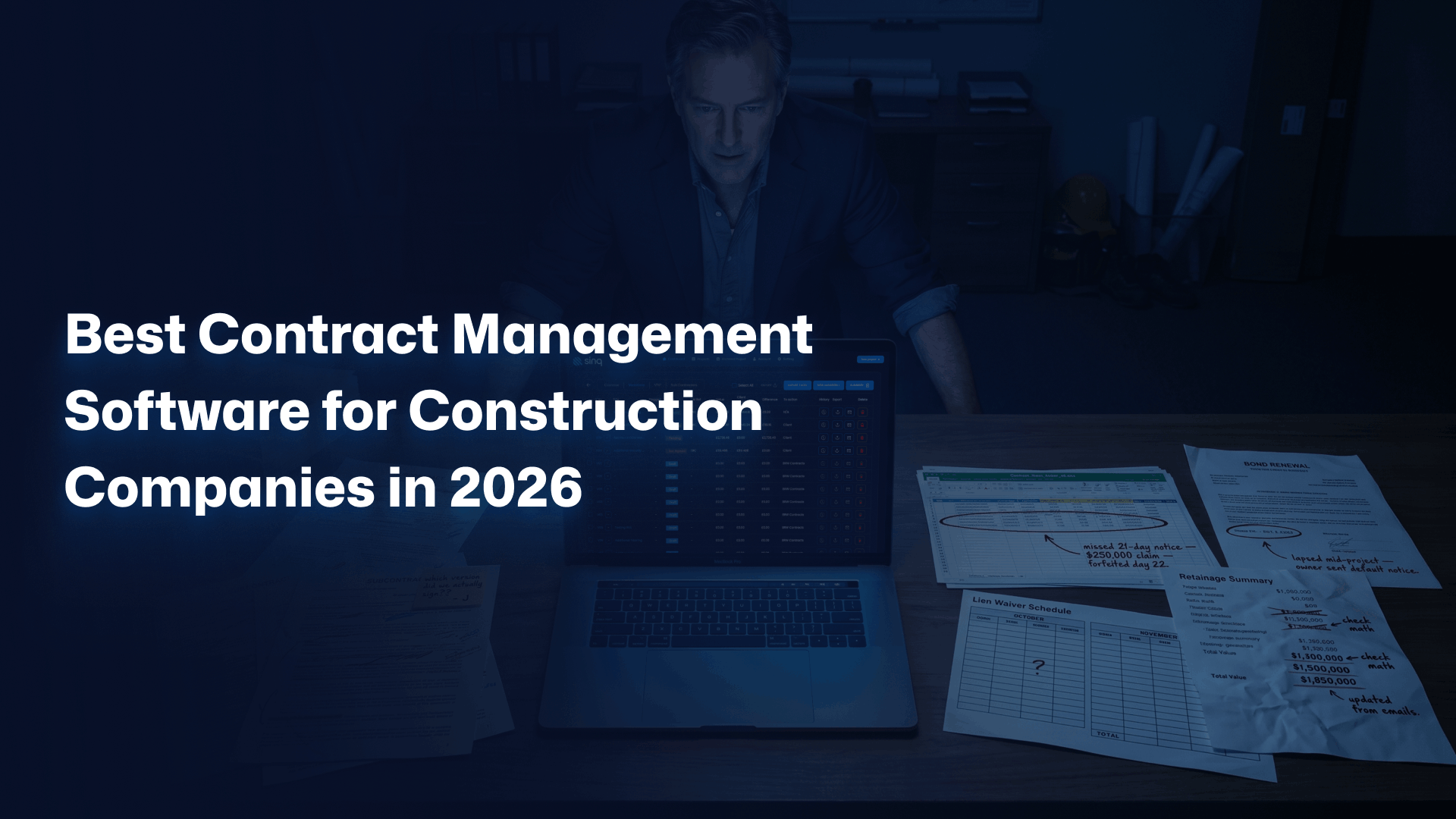
Consider a general contractor that misses a 21-day notice window on a differing-site-condition claim worth $250,000. The work was real. The cost was real. The right to recover it died on day 22, because the only thing tracking that deadline was a row in a file nobody opened. Software would have flagged it on day 14. The spreadsheet flagged nothing.
Already know spreadsheets are costing you? See how a purpose-built system handles your contracts without the babysitting. Talk to Sinq when you are ready, no pitch deck, no pressure.
Must-Have Features in Construction Contract Management Software
The best construction contract management software shares a core set of non-negotiable features: centralized document control, automated obligation and renewal alerts, structured approval workflows, change order linkage, compliance tracking for insurance and lien waivers, and a complete audit trail. These are not enterprise extras. They are the baseline any contractor running more than a handful of contracts needs to protect margin and stay out of disputes.
Strong contract management for construction treats each of these features as part of one connected system rather than a menu of modules you bolt on. The value is in the connections: an alert that fires, a workflow that routes, and a record that holds. Evaluate any platform on whether these pieces work together, not on how many boxes the feature list checks.
Centralized Repository With Real Search and Permissions
Every contract, amendment, and supporting document belongs in one searchable repository with role-based permissions. A QS should find the indemnity clause in a $3 million subcontract in seconds, not by opening 40 PDFs. Permissions matter as much as search: the field team needs scope and schedule, the commercial team needs payment and retainage terms, and not everyone should edit the master agreement. A central repository without permission control is just a shared drive with better marketing.
The test is simple. Can you answer, in under a minute, which contracts contain a specific liquidated-damages clause across all active projects? If the answer requires manual file-by-file review, you do not have contract management. You have storage.
Automated Alerts for Renewals, Deadlines, and Obligations
Automated alerts are the feature that earns the subscription on its own. Construction contracts are dense with dates: notice deadlines, milestone obligations, insurance renewals, warranty periods, and option windows. Miss one and the consequence is rarely small. The software should fire alerts well before each deadline, route them to the responsible person, and escalate when they go unacknowledged. A deadline that depends on someone remembering it is a deadline you will eventually miss.
Picture a contractor with a bond renewal lapsing mid-project on a public job. The lapse alone can trigger a default clause. An automated system flags the renewal 30 days out and again at 10. Manual tracking flags it the day the owner sends a default notice. One outcome is a calendar reminder. The other is a stop-work order.
Approval Workflows and a Full Audit Trail
The audit trail is your legal protection. Every action on a contract, who drafted it, who approved which version, when each amendment was executed, must be timestamped and immutable. When a payment dispute reaches mediation or litigation, that record decides whether your position is provable or merely remembered. Approval workflows enforce sequence so contracts cannot be executed without the right sign-offs, and amendments cannot slip through without a tracked version.
Ask any vendor a single question: what does my audit trail look like if a dispute surfaces a year after closeout? If the answer is vague, the protection is vague. Keep looking until the answer is specific.
How Contract Software Connects to Change Orders and Compliance
Contract management software connects to change orders by making the signed contract the baseline that every variation is measured against, and to compliance by linking obligations like insurance and lien waivers directly to each agreement. Change orders that drift from the contract scope are where disputes start, and compliance gaps are where claims die. A connected platform catches both before they cost you. Roughly 56% of construction cost overruns trace back to design and scope changes, which makes that contract-to-change-order link the most valuable connection in the system.
Think of the contract as the foundation and change orders as the additions built on top of it. If the foundation is documented and the additions are tracked against it, the structure holds under scrutiny. If the additions are managed in a separate tool that never talks to the contract, every change order becomes an argument about what the original agreement actually said.
Contract Software and Change Order Software: Where They Meet and Where They Differ
Contract management and change order management overlap, but they are not the same job. Understanding the line helps you avoid buying two tools that do not connect, or one tool that does half of each badly. The distinction comes down to scope and timing.
The clearest way to frame the contract software vs change order software decision is by what each one governs. Contract software governs the agreement: the terms, the obligations, the compliance, the full lifecycle. Change order software governs the variations to that agreement: the scope changes, the pricing, the approvals, the billing impact. The best platforms treat them as one continuous record, because a change order is just an amendment to a contract obligation you already agreed.
Manage them in disconnected tools and the seam shows immediately. A change order gets approved in one system while the contract value sits unchanged in another. The budget drifts. The forecast lies. By closeout, the two records disagree, and reconciling them becomes a manual project of its own. Not a contract problem. Not a change order problem. A connection problem, and connection is the whole value.
Compliance Tracking: Insurance, Lien Waivers, and Prequalification
Compliance in U.S. construction is a moving target with legal consequences. Subcontractor insurance certificates expire mid-project. Lien waivers must be collected at each payment to keep your own payment rights clean. Prequalification documents need refreshing on multi-year work. A contract platform that tracks these obligations against each agreement turns compliance from a fire drill into a routine the software runs for you.
Consider a general contractor releasing a $400,000 progress payment to a sub whose general liability coverage lapsed two weeks earlier. If an incident occurs, the GC may carry the exposure the sub’s policy should have covered. Software flags the lapsed certificate before the payment releases. A folder of PDFs flags nothing, and the gap only surfaces after the claim arrives.
U.S.-Specific Contract Requirements Your Software Cannot Ignore
The U.S. construction market runs on specific contract structures and legal rules that shape what your software must handle. AIA and ConsensusDocs agreements, state mechanics lien statutes, retainage law, and federal acquisition clauses all impose requirements a generic contract tool ignores. A platform built without them does not just inconvenience you. It leaves legal gaps that surface as forfeited claims and unenforceable terms.
This is the layer where international or generic contract software breaks for American builders. The terminology is different, the standard forms are different, and the compliance deadlines carry real statutory weight. The best contract management software for U.S. construction companies treats these requirements as core, not as an afterthought bolted on for one market.
AIA and ConsensusDocs Contract Families
Most U.S. commercial and institutional work runs on standardized contract families, and your software should speak their language natively. The AIA Contract Documents family is the most widely used set of standard agreements in American construction, governing everything from owner-contractor agreements to change orders and payment applications. ConsensusDocs offers a competing family favored on many collaborative and design-build projects. Contract software that cannot map to these structures forces manual rework on nearly every commercial job.
Native support means the software understands the relationships these documents define: the prime agreement, the general conditions, the subcontract that flows down terms, and the change order that amends them. When your platform knows that a flow-down clause ties a subcontract to the prime, it can flag conflicts before they become disputes. When it treats every document as an unrelated PDF, you inherit the reconciliation work.
Retainage, Lien Waivers, and Mechanics Lien Deadlines
Retainage and lien rights are where U.S. contract administration gets unforgiving. Every state sets its own retainage limits, release timing, and mechanics lien notice deadlines. Miss a preliminary notice window and you can forfeit lien rights on work you already performed. Release a payment without collecting the corresponding conditional waiver and you muddy your own position. These are not paperwork niceties. They are the difference between a recoverable claim and a written-off loss.
Your contract software should track retainage balances across every project in real time, schedule lien waiver collection at each payment, and flag mechanics lien deadlines by jurisdiction. A contractor carrying $600,000 in aggregate retainage across nine projects needs to know exactly when each release is due and what conditions gate it. Tracked manually, that figure is always an estimate. Tracked by software, it is a number you can act on.
Federal Contracts and FAR Compliance Clauses
Federal construction adds another layer of contractual rule that punishes informal tracking. Changes, claims, and equitable adjustments on federal work are governed by Federal Acquisition Regulation clauses with strict notice and documentation requirements. Constructive changes must be documented and noticed within defined windows, or the right to an equitable adjustment evaporates. The government does not pay adjustments that are not claimed correctly and on time.
The full text of the governing rules lives in the Federal Acquisition Regulation, and contractors on federal projects are held to its notice timelines whether or not they track them. Software that captures FAR-required deadlines and documentation fields turns a bureaucratic trap into a billing opportunity. Without it, equitable adjustment rights are routinely forfeited on work that was genuinely performed.
Best Contract Management Software for Construction Companies in 2026: Full Comparison
The market for contract management software for construction has split into three groups: enterprise construction suites with contract modules, horizontal contract lifecycle tools adapted from other industries, and purpose-built commercial control platforms designed for how contractors actually work. Each group solves a different problem, and the wrong fit costs you in adoption, integration, and the obligations that fall through the gaps. Here is how the leading options compare on what matters most.
Quick-Comparison Breakdown of Construction Contract Platforms
| Platform | Best For | Pricing Model | Change Order Linkage | AIA Support | Compliance Tracking | Construction-Native |
| Sinq | Contractors and commercial teams | Subscription, transparent | Yes, integrated | Yes | Full | Purpose-built |
| Procore | Large GCs and ENR firms | Enterprise, high cost | Yes | Yes | Full | Yes, GC-centric |
| Autodesk Construction Cloud | Design-build and large projects | Enterprise tiered | Yes | Partial | Moderate | Yes |
| DocuSign CLM | Cross-industry contract teams | Per-user enterprise | No | No | Generic | No, horizontal |
| Juro | General business contracts | Tiered subscription | No | No | Generic | No, horizontal |
| Buildertrend | Residential builders | Tiered monthly | Partial | Partial | Basic | Residential focus |
Sinq: Contract and Commercial Control Built for Contractors
Most contract platforms are built top-down for owners and large general contractors, then adapted for everyone else as a secondary use case. Sinq starts from a different place: the commercial reality of contractors and subcontractors who have to defend margin against a contract someone else drafted. It is built around variation and contract change management, the point where most construction contracts actually leak money, rather than around legal document storage.
That focus shapes the platform. The approval workflows follow the submission chains contractors actually use. The cost tracking captures margin exposure on variations against the signed contract, not just a high-level project budget. The audit trail is designed to hold up when a contractor pursues payment or defends a claim. For a commercial team running a dozen contracts, Sinq answers the questions that keep a QS up at night: which obligations are due, which variations are unapproved, and what the total exposure is if none of them resolve in your favor.
Evaluating the top contract management software for a construction business comes down to one test: does the tool understand contracts as commercial instruments or as documents to file? Sinq treats every contract as a set of obligations with money attached, and every variation as evidence to be captured before the moment passes. That is commercial control, not document management, and it is what protects a contractor margin in practice.
Want to see what commercial control looks like for your contracts? Sinq is built for contractors and commercial teams who are done losing margin to obligations that slipped through the cracks. Book a quick conversation with Sinq and bring one messy contract to talk through, no pitch deck, no pressure.
How to Choose Contract Management Software That Fits Your Business
Choosing contract management software is not about the longest feature list. It is about finding the system your team uses on every contract, from first draft to final waiver, without being chased. A platform that sits unused is a subscription with no return. The right choice depends on your contract volume, your project types, your existing tools, and the obligations that hurt most when they slip. Match the tool to the pressure, not to the marketing.
Questions to Ask Any Vendor Before You Commit
Evaluate every vendor against a short list of questions that reveal whether they understand construction. How does your platform track a state-specific mechanics lien deadline? What happens to my contract data and audit trail if I cancel? Can your system link an approved change order back to the original contract value automatically? Does it flag a lapsed insurance certificate before a payment releases? The answers separate platforms built by people who know construction from platforms built by software teams who studied it from the outside.
The gap shows in moments of conflict, never in the demo. A polished demo proves the software is easy to show. The questions above prove whether it holds up the day a $250,000 obligation comes due and you need the system to have been watching it all along.
Matching the Tool to Your Company Size
Company size changes the right answer more than any feature comparison. A regional general contractor running 40 concurrent contracts needs deep workflow configuration and multi-project rollup. A specialty sub running lean needs fast capture, clean alerts, and no implementation marathon. Buying enterprise software for a five-person shop creates an administrative burden nobody has time to maintain. Buying a thin tool for a large firm leaves obligations untracked at scale.
If you run a smaller shop, start by mapping the wider toolkit before you isolate contracts, because the right software for small construction companies works as a connected stack rather than a pile of disconnected subscriptions. Contract management earns its place in that stack when it talks to your billing, your change orders, and your field capture. A tool that lives on its own island just adds another login and another place for obligations to hide.
Pricing Reality Check for 2026
Pricing in this category spans an order of magnitude. Enterprise construction suites can run $375 to $800 per month for a base module and climb fast with seats and add-ons. Horizontal contract lifecycle tools charge per user and rarely include construction-specific compliance. Purpose-built platforms like Sinq offer transparent subscription pricing without the implementation overhead. The headline price is the least useful number in the decision.
The real question is what a single protected obligation is worth. If the software flags one notice deadline that preserves a $250,000 claim, or catches one lapsed certificate before a payment releases, it has paid for years of subscription in a single afternoon. Price the outcome, not the monthly fee. Contractors who buy on sticker price alone consistently underestimate what an unmanaged contract actually costs them.
Who Actually Needs Contract Management Software in Construction?
The honest answer: any construction business that has ever lost money to a missed deadline, a disputed scope, or a compliance gap it could not document. That covers most of the industry. But the specific exposure differs by role, and knowing where your risk concentrates helps you choose the right system rather than the most advertised one. The need is universal. The shape of it is not.
General Contractors and Commercial Managers
General contractors and commercial managers carry the broadest contract exposure in the industry. A single GC may hold a prime agreement with the owner and 30 or more subcontracts beneath it, each with flow-down terms, insurance requirements, and retainage schedules. When one subcontract obligation slips, the consequence often rolls up to the prime and lands on the GC. Commercial managers live in this exposure daily, defending margin against terms drafted by owners and tracked across systems that rarely talk to each other.
Industry bodies have documented this pressure for years. The Associated General Contractors of America consistently identifies contract administration and risk transfer as central concerns for member firms, particularly as flow-down clauses push more obligation onto contractors. For a commercial manager, software that tracks every flow-down term against its source contract is not a convenience. It is the difference between managing risk and absorbing it.
Subcontractors and Specialty Trades
For subcontractors and specialty trades, contract management is a survival mechanism, not an efficiency upgrade. You work under terms a GC drafted, on a payment cycle you do not control, with lien rights that depend on documentation deadlines you must hit precisely. When a variation enters the GC approval process, you need visibility into where it sits and a clean record if it becomes a dispute. Subcontractors sit furthest from the owner approval authority and closest to the cash-flow consequences when payment stalls.
A specialty trade carrying $85,000 in unapproved variations across four projects needs to know which are pending, which are overdue for response, and what the total exposure is if none get paid. That is contract and variation control at the trade level, and it is exactly the gap purpose-built software closes.
Small Construction Businesses Running Lean
Small construction businesses face a specific bind: the processes that would protect them take time the team does not have, because everyone already wears five hats. Contract software for a small builder has to be fast to set up, usable without training, and effective on day one without a configuration marathon. The right platform is not the one with the most features. It is the one that surfaces the three obligations that matter most, from a phone, in the time it takes to walk a site.
That bar is higher than it sounds. Most enterprise tools fail it badly. The platform that wins for a lean team is the one a busy project manager actually opens during a job, not the one that requires a dedicated administrator to keep current.
Contract Management Mistakes U.S. Builders Keep Repeating
The same contract mistakes recur on project after project, firm after firm. They are not the product of carelessness. They are the product of systems that leave gaps between what was agreed, what was tracked, and what can be proven. Software closes those gaps by making the correct action the easiest action at every stage. The mistakes below cost the industry billions, and almost all of them are preventable with a system that watches the obligations people forget.
Treating the Signed Contract as the Finish Line
The most expensive mistake is mental: treating signature as the end of contract work rather than the start. Teams negotiate hard, sign, then file the agreement and run the project on memory. Every obligation the contract created, every deadline, every compliance requirement, every notice window, sits dormant until something goes wrong. The contract was the beginning of the work, not the end of it. A platform that activates those obligations on signature turns a static document into a system that manages itself.
Construction rework and delays cost the U.S. industry an estimated $177 billion a year, and a meaningful share traces to obligations that were agreed but never managed. The contract is not the finish line. It is the operating manual for everything that follows.
The Honest Case for Sticking With Spreadsheets, and Where It Breaks
Here is the fair concession. For a contractor running two or three simple contracts a year, a well-maintained spreadsheet genuinely works. The overhead of dedicated software may not pay off at that volume, and a disciplined owner who personally tracks every deadline can keep a small operation clean. This is not about spreadsheets being worthless. It is about recognizing where they stop scaling.
That break point arrives faster than most firms expect. The moment you cross roughly ten concurrent contracts, add a second person who needs the same data, or take on work in multiple states with different lien rules, the spreadsheet stops being a tool and starts being a liability. The question is not whether spreadsheets can work. It is whether yours still does at the volume you actually run today.
Ignoring Compliance Until an Audit or Claim Forces It
Compliance gets ignored because it feels like overhead until the exact moment it becomes everything. Insurance certificates lapse quietly. Lien waivers go uncollected. Prequalification documents go stale. None of it hurts until an incident, an audit, or a payment dispute drags the gap into the light, and by then the cost is fixed and the window to fix it has closed. Treating compliance as a routine the software runs, rather than a scramble before a deadline, is how disciplined firms stay out of that trap.
A contractor that releases payments without tracking waiver collection can find its own lien rights compromised months later, on work it fully performed. The waiver was a two-minute task at payment time. The consequence is a five-figure write-off and a dispute nobody needed. Software makes the two-minute task automatic. Memory makes it optional, and optional compliance is the same as no compliance.
Frequently Asked Questions
What Is the Best Contract Management Software for Construction Companies in 2026?
Sinq ranks among the best contract management software for construction companies in 2026 because it is built around the commercial reality contractors face, not adapted from a generic legal tool. The best platform for your business links contracts to change orders, tracks compliance obligations automatically, and holds a defensible audit trail. Evaluate options on adoption ease and construction-native features as much as price. The tool your commercial team actually uses on every contract is worth far more than the one with the longest feature list sitting unused.
Why Do Spreadsheets Fail at Construction Contract Management?
Spreadsheets fail because they track data without enforcing obligations and cannot alert you to a single deadline. A contractor running 15 to 40 concurrent contracts cannot reliably manage notice windows, retainage releases, and insurance renewals in a static file that depends on one person updating it. The spreadsheet stays silent when a notice deadline approaches and offers no audit trail when a dispute arrives. It works at two or three contracts and quietly breaks at scale, usually right when the stakes are highest and the missing deadline becomes a forfeited claim.
How Does Contract Management Software Connect to Change Orders?
Contract management software connects to change orders by making the signed contract the baseline that every variation is measured against. When a change order is raised, the platform links it to the original scope and value, updates the contract sum on approval, and records the full trail of who approved what and when. This prevents the budget drift that happens when change orders live in a separate tool that never updates the contract. Since scope and design changes drive roughly 56% of construction cost overruns, that contract-to-change-order link is the single most valuable connection in the system.
Is Contract Management Software Worth It for Small Construction Businesses?
Yes, once a small business crosses roughly ten concurrent contracts or works across multiple states with different lien rules. Below that volume, a disciplined spreadsheet can hold. Above it, the risk of a missed deadline or compliance gap outweighs the subscription cost quickly. The right platform for a small builder is fast to set up, usable without training, and effective on day one. Price the outcome rather than the monthly fee: a single notice deadline preserved or one lapsed certificate caught before payment can cover years of subscription in a single afternoon.
What Features Should Construction Contract Management Software Have?
The features that actually matter come down to six non-negotiables: a centralized repository with real search and role-based permissions, automated alerts for renewals and obligation deadlines, structured approval workflows with a full audit trail, direct change order linkage to the contract, compliance tracking for insurance and lien waivers, and native support for U.S. contract families like AIA documents. Secondary features include multi-project dashboards, retainage tracking by jurisdiction, and federal compliance fields for FAR clauses. The core six protect your rights and margin. The rest improve efficiency once the foundation is solid.
Take Control of Your Contracts Before They Control Your Margin
Every contract you have signed and filed away is a set of live obligations, not a closed deal. It carries deadlines you must hit, compliance you must maintain, and scope you must defend when a change order tests it. The longer those obligations sit untracked, the more they cost. Disputes replace conversations. Memories replace records. The clause that would have protected you goes unread until the day it cannot help you anymore.
The best contract management software for construction companies in 2026 does not solve a filing problem. It solves a commercial control problem. It gives you visibility into every obligation across every active contract, a workflow that moves each one toward resolution, and an audit trail that backs up every dollar you claim. That is the difference between managing your contracts and merely storing them.
Contractors who manage contracts with discipline do not just avoid disputes. They hold stronger negotiating positions, protect their margins, and close projects with the profit they earned intact. Sinq exists for exactly that: giving contractors and commercial teams the control to track every obligation, capture every variation, and defend every dollar a contract promised them.
Ready to stop losing margin to obligations you never saw coming? Sinq gives contractors and commercial teams one system to track contracts, change orders, and compliance in real time. Start a conversation with Sinq and walk through your current contracts together, no pitch deck, no pressure.
Your contracts. Your margin. Your control.