
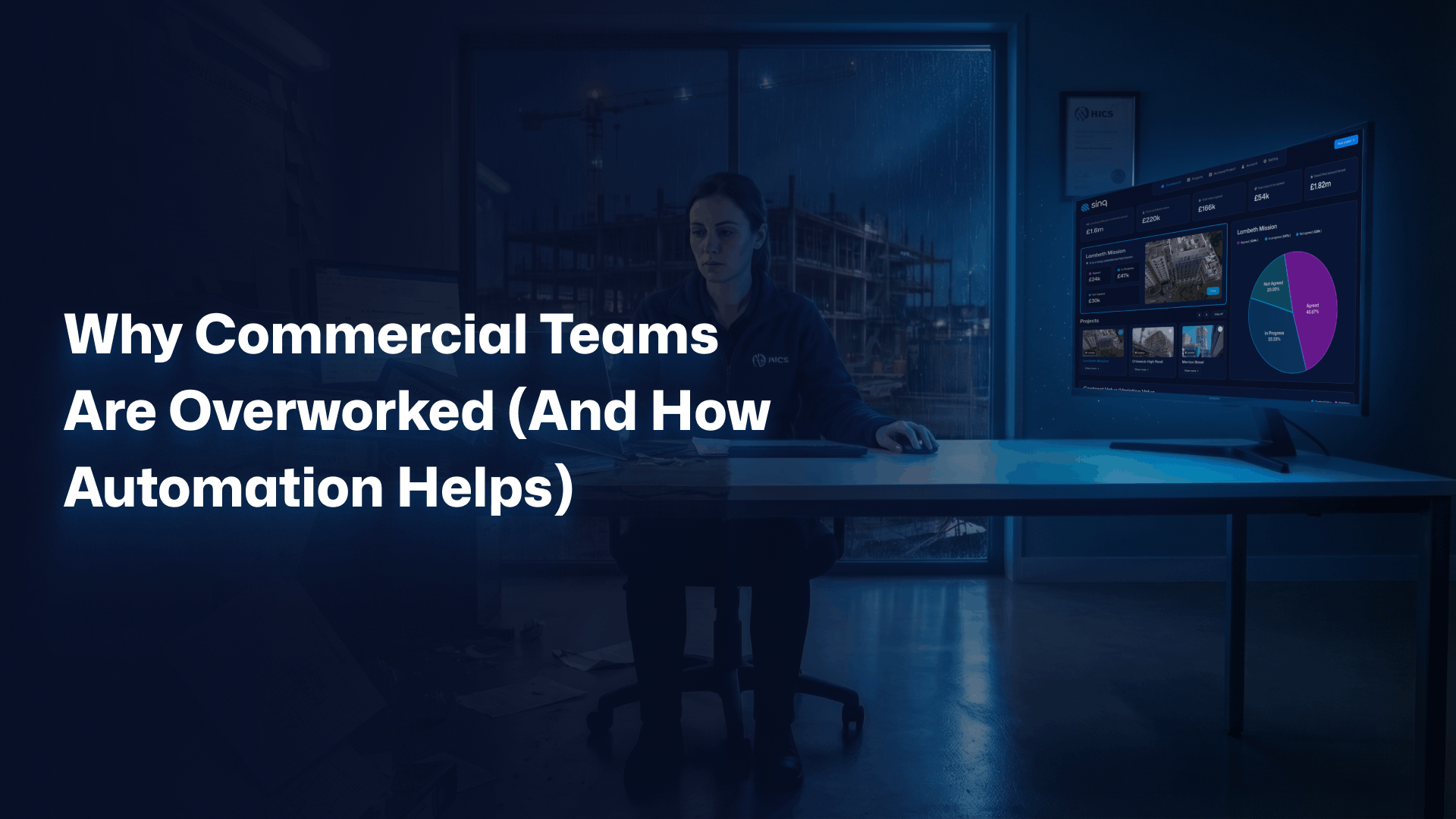
The QS on your most complex live project is good at their job. Genuinely good: technically sharp, commercially aware, experienced enough to spot a dispute coming before it arrives. And they spend roughly a third of their working week copying information between a spreadsheet, an email, and a variation register that needs updating before Friday’s application deadline.
Not reviewing risk. Not preparing the commercial strategy for final account. Not having the proactive client conversation that would resolve the disputed variation before it becomes an adjudication. Copying information. Reformatting data. Chasing site managers for photographs that should have been submitted three weeks ago. Rebuilding a variation record from email chains because the site team raised the instruction verbally and the follow-up never arrived.
This is why UK construction commercial teams are overworked, and it has almost nothing to do with project complexity or team size. It has everything to do with the administrative infrastructure the commercial function is running on: tools that were designed for data storage rather than process management, workflows that rely on individual effort rather than systematic automation, and a model that makes the QS responsible for assembling the commercial record rather than analysing it.
According to RICS research on commercial management in UK construction, quantity surveyors spend an average of 35 to 40 percent of their working time on administrative tasks that do not directly generate commercial value: data entry, report preparation, chasing information from site teams, and reformatting records for submission. On a team of four QSs, that is the equivalent of 1.4 to 1.6 full-time roles consumed by administration rather than commercial management.
Variation order software and construction variation management software address this directly not as productivity tools for individual QSs, but as process infrastructure that removes the administrative load from the commercial function and returns that capacity to the work it was hired to do. The rest of this article explains how, and why most contractors haven’t made the transition yet.
The Administrative Trap: How Construction Commercial Work Got So Manual
There’s a commonly held belief in UK construction that commercial administration is simply part of the job that the QS role has always involved a certain volume of manual work, and that this is an acceptable trade-off for the complexity and value of the discipline. It isn’t a belief that anyone states explicitly. It’s built into how teams are hired, how workloads are set, and how performance is assessed.
The problem with this belief is that it was formed in a different era of construction commercial management. When variation registers were maintained in lever-arch files and monthly applications were typed up from site diaries, the manual work was the process. There was no alternative. The administrative burden was the unavoidable cost of managing commercial change.
That era ended. The tools that replaced the lever-arch files, by and large, were spreadsheets and email which reduced some of the physical effort while preserving most of the structural inefficiency. The QS is still the person responsible for collecting information, manually entering it into a tracker, chasing approvals through a communication channel that doesn’t create a structured record, and assembling the evidence package retrospectively when someone finally asks for it.
The construction QS workload management problem isn’t that there’s too much work. It’s that the wrong person is doing the wrong tasks using the wrong tools. And the commercial team has absorbed this as normal for long enough that nobody is asking the right question: what would the QS be doing with that thirty to forty percent of their time if the administration ran itself?
What “Manual Admin” Actually Costs a Commercial Team
The abstract claim that “QSs spend too much time on admin” is easy to acknowledge and easy to ignore. The specific calculation is harder to dismiss.
Take a commercial team of three QSs on a contractor running eight live projects simultaneously, with an average variation volume of twenty-five variations per project per month across the portfolio. Each variation requires: a record to be created or updated in the tracker, a cost assessment, an approval to be chased or confirmed, a notification to be issued to the relevant parties, and a status update in the monthly application. At an optimistic average of twenty minutes of administrative work per variation at each stage, the team is spending roughly 200 hours per month on variation administration across the portfolio.
200 hours. Across a three-person commercial team working standard hours, that is 25 working days. More than a full month of combined commercial capacity consumed by variation administration every single calendar month.
That number doesn’t include the time spent preparing the monthly commercial report, attending the valuation meetings, responding to client queries on previously submitted variations, or managing the subcontractor application process. Those are additional. The 200 hours is the baseline cost of keeping the variation register current.
The best construction variation management software for commercial team efficiency reduces that baseline by automating the tasks that don’t require QS judgement: capturing the variation record at the point of instruction via a mobile app, routing the approval to the correct party through a defined workflow, issuing notifications automatically when approvals are received or overdue, and updating the register in real time without requiring manual entry. The QS reviews, assesses, and decides. The system collects, records, and communicates.
The difference in that division of labour is not marginal. It is the difference between a commercial team that is perpetually behind and one that is consistently ahead.
The Real Cost of a QS Spending Half Their Day on Data Entry
There is a second cost to the administrative overload problem that rarely appears in the commercial team efficiency conversation: the cost of what the QS isn’t doing because they’re occupied with administration.
A QS spending thirty-five percent of their time on manual variation administration is a QS who is spending thirty-five percent less time on the work that actually protects project margin. Early identification of commercial risk. Proactive management of the approval cycle to prevent valuation delays. Strategic preparation of the final account position before practical completion rather than after. Challenging design changes that should be instructed as variations rather than absorbed as scope. The work that turns a good commercial result into an excellent one.
This isn’t a soft benefit. It is a measurable commercial outcome. A QS who can identify a disputed variation six weeks before final account has time to strengthen the evidence, seek clarification, and resolve the position before it becomes a claim. A QS who is still catching up on last month’s variation register when the project hits practical completion is negotiating from a defensive position that was entirely preventable.
Consider what that means for a contractor running eight projects simultaneously. If each project loses an average of £15,000 in variation entitlement at final account because the commercial team didn’t have capacity to manage the position proactively, the annual commercial impact of QS administrative overload is £120,000. Not in staff costs. In unrecovered entitlement. That number doesn’t appear on the budget. It appears in the difference between the expected margin and the delivered one.
How variation order software reduces QS administrative workload isn’t a conversation about convenience. It is a conversation about commercial outcomes.
Why Chasing Approvals Is a Full-Time Job Nobody Hired Anyone to Do
Ask a QS on a live UK construction project how much time they spend chasing variation approvals in a typical week. The answers tend to cluster around three to five hours: emails sent and re-sent, calls made to the client’s QS, follow-up messages to site managers who were supposed to submit additional evidence and haven’t. Five hours a week across a forty-eight-week project is 240 hours of commercial capacity spent on a task whose entire value is prompting someone else to do something they were already supposed to do.
The chasing problem is a process design failure, not a people failure. Approvals sit in queues because the approval process doesn’t have built-in escalation: nobody is automatically notified when an approval is overdue, no flag appears in the client’s system when a variation has been waiting for fifteen days, and the only mechanism for moving a stalled approval forward is a QS with a phone and a good relationship with the client’s team.
Automated variation approval workflow solves this at the architecture level rather than the relationship level. When an approval hasn’t been received within a defined period, the system issues an automatic reminder to the relevant party. When a variation has been outstanding for more than the configured threshold, it is flagged for escalation in the commercial manager’s dashboard. The QS doesn’t need to remember to chase because the system doesn’t forget.
This is the difference between variation process automation as a concept and as a practical working reality: not an AI system making commercial judgements, but a structured workflow that handles the mechanical tasks of routing, notification, and escalation automatically while leaving the decisions where they belong with the QS who understands the project.
Sound familiar, that chasing cycle? It should. And it shouldn’t still be happening in 2025.
The Site Team Problem: Why Information Doesn’t Flow Upward Automatically
The commercial team’s administrative burden isn’t only generated by the approval process. A significant portion of it is created by the gap between the site team and the commercial office: variations that happen on site but don’t reach the QS with the information needed to process them properly.
The site manager raises a verbal instruction, makes a note, and moves on to the next problem. The follow-up never arrives or arrives three weeks later without photographs, without a clear scope description, and without the specific instruction reference that would allow the QS to locate the relevant contract provision. The QS now has three options: chase the site manager for the missing information, raise the variation with incomplete detail and accept the scrutiny it will attract at valuation, or absorb the cost into a general account and hope it surfaces at final account. None of those options is good.
How automation helps construction commercial teams manage more projects is partly about the back-office workflow and partly about closing this site-to-office information gap. A mobile VRF tool that allows the site manager to raise a variation directly from site title, description, photographs captured at the point of instruction, submitted in under two minutes removes the dependency on a follow-up that often never comes. The information enters the commercial system at the point it is created rather than days or weeks later when the evidence has degraded and the QS has to reconstruct what happened from incomplete inputs.
The commercial team receives a complete variation record. They don’t receive a request to complete one.
That is not a small operational improvement. On a project generating thirty new variations per month, if each previously incomplete site submission required an average of forty-five minutes of QS time to chase and reconstruct, eliminating that reconstruction work returns twenty-two hours of commercial capacity per month to the team. Per project. Twenty-two hours that can go toward the work that actually generates commercial return rather than compensating for a process that was never designed well enough.
How Automated Reporting Replaces Four Hours of Monthly Assembly
Every commercial manager in UK construction knows the experience of the monthly report: a process that starts on the Wednesday before the Thursday deadline and involves extracting information from three different systems, cross-referencing a variation register that was last updated with varying degrees of rigour by three different QSs, and producing a document that is already slightly out of date by the time it reaches the meeting.
The monthly report isn’t a reporting failure. It is a data architecture failure. The information that should be in the report exists, somewhere, across the commercial team’s various tracking systems, email chains, and project files. The four-hour assembly exercise is the cost of that information being fragmented rather than centralised.
Automated variation tracking for UK builders produces the commercial report as a continuous output rather than a periodic exercise. Because every variation is captured in a single system, assessed in real time, and updated as approvals are received, the commercial dashboard reflects the current state of the project portfolio at any point not the state it was in when someone last updated the spreadsheet.
The commercial manager who arrives at the Thursday meeting with a live dashboard rather than a compiled report isn’t just better prepared. They’re managing from current information rather than historical information. The decisions that come out of that meeting are based on what is happening now, not what happened three to four weeks ago. For a function where the primary value is anticipating risk rather than documenting it, the distinction between current and historical information is not a nice-to-have. It is the difference between being ahead of the problem and behind it.
The Honest Concession: Automation Doesn’t Replace Commercial Judgement
There is a version of the automation argument that overclaims. It suggests that variation order software can replace experienced commercial management, that automated workflows eliminate the need for QS judgement, and that the commercial team’s role is reduced to oversight once the right platform is in place.
That version is wrong, and it’s worth addressing directly rather than leaving it as an implied assumption.
The work that matters most in construction commercial management is the work that requires professional judgement: assessing whether a change falls within the original scope or creates new entitlement, valuing complex variations with interdependent cost and programme implications, managing the client relationship in the final account negotiation, and identifying patterns of instructed change that signal a systemic scope problem rather than isolated variations. None of that is automatable. All of it requires a QS with experience, project knowledge, and commercial instinct.
What automation replaces is the work that doesn’t require those things: data entry, approval chasing, report assembly, notification management, and the mechanical process of keeping the variation register current. These tasks are necessary. They are not valuable in themselves. They are the overhead cost of running a commercial function rather than the function itself.
The right framing is not “automation instead of QSs.” It is “automation handles the administration so QSs can focus on the judgement.” A commercial team operating on that model doesn’t just work more efficiently. It produces consistently better commercial outcomes because the people capable of generating those outcomes are spending their time on the work that generates them.
What the Commercial Team Looks Like When Administration Runs Automatically
Picture a commercial team of three QSs running eight live projects after transitioning to an automated variation order software platform. The Monday morning dashboard shows every project’s variation status, current unapproved exposure, approvals overdue for escalation, and subcontractor applications outstanding. The information is current because it was updated in real time across the weekend as notifications cleared and new variations were submitted from site.
Each QS reviews their projects in thirty minutes rather than the hour and a half previously spent collating information from separate systems. The morning is spent on commercial work: a QS reviewing a subcontractor’s variation valuation and identifying that it includes items already covered by a provisional sum; another preparing the commercial position for a project approaching practical completion, with a variation register that’s complete and evidenced because the site team has been raising VRFs through the mobile app for eight months; the third attending a client meeting with a real-time cost dashboard on their screen rather than a printed report prepared the day before.
The monthly commercial report is produced in twelve minutes by exporting the dashboard. The chasing calls don’t happen because the approval reminders were sent automatically three days ago. The site managers aren’t being asked for information that should have come with the original variation submission because the mobile app required it at the point of raising.
This isn’t a vision. It is the practical output of replacing manual administration with automated process infrastructure.
How to automate variation approvals on UK construction projects starts with a single question: which tasks in your current variation management process require QS judgement, and which require only that someone collects and routes information correctly? Everything in the second category is a candidate for automation. Most UK commercial teams will find that the second category is larger than the first.
Evaluating Whether Your Commercial Team Is Over-Administrated
The test is practical. Run it on your own team.
Ask each QS to record how they spend their time for one week specifically separating tasks that require commercial judgement from tasks that require data collection, entry, formatting, or chasing. Don’t filter the results. Look at the raw breakdown.
Most commercial teams that run this exercise find the same thing: forty to fifty percent of the week goes to tasks that a well-designed automated system could handle without human involvement. The QS isn’t doing that work because it’s the best use of their time. They’re doing it because the system they’re working in requires them to.
Evaluate the last three final accounts on completed projects. For each one, assess how much time the QS spent in the final six weeks before practical completion managing the variation record versus managing the commercial strategy. If the answer is more record management than commercial strategy, the administration burden is affecting outcomes, not just efficiency.
Look at your variation register on any live project right now. How current is it? When was it last updated, by whom, and how long would it take to bring it fully current if you needed it for a valuation meeting tomorrow? The answer tells you whether the commercial record is a live management tool or a retrospective document.
Those three exercises produce an honest assessment of whether your commercial team is over-administrated. For most UK contractors running their process on spreadsheets and email, the answer will be yes and the cost will be higher than the administration overhead alone suggests.
The Commercial Team You Actually Want Is One System Away
The commercial function that most UK contractors are trying to run proactive, ahead of the project, managing risk rather than documenting it requires a QS whose time is spent on the work that justifies their day rate. Not on copying data between systems. Not on chasing approvals through email chains. Not on reconstructing variation records from site diary notes and forwarded messages.
Construction variation management software built specifically for UK contractors who have recognised that the administrative overhead of their current variation process is a commercial liability can transform how the team operates. The mobile VRF tool closes the site-to-office information gap. The automated approval workflow eliminates the chasing cycle. The real-time dashboard replaces the monthly assembly exercise. The full variation lifecycle runs through one system, generating the commercial record as a continuous output rather than a retrospective reconstruction.
The QS capacity that’s currently consumed by administration gets returned to commercial management. The team that’s perpetually behind becomes the team that’s consistently ahead. The final account that was heading for a surprise becomes the final account that was managed into a clean result.
Your commercial team’s time is too expensive to spend on administration.
Frequently Asked Questions
Why are UK construction commercial teams overworked?
The core reason is that most commercial teams are running a variation management process designed for manual administration: data is collected by people, entered by people, routed by people, and chased by people, even when the tasks involved don’t require commercial judgement. RICS research indicates that QSs spend 35 to 40 percent of their working time on administrative tasks that could be automated. On a team of three, that is the equivalent of more than a full-time role consumed by administration every month capacity that could be applied to the commercial work that protects project margin.
How does variation order software reduce QS administrative workload?
It automates the tasks that don’t require commercial judgement: capturing the variation record at the point of instruction via a mobile app, routing approvals through a defined workflow with automatic reminders for overdue responses, updating the variation register in real time without manual entry, and generating commercial reports directly from the live data rather than requiring manual assembly. The QS reviews, assesses, and decides. The system collects, records, routes, and reports. The division of labour returns significant commercial capacity to the work that generates value.
How does construction variation management software improve commercial team efficiency?
By making the right process the automatic output of the normal workflow rather than an additional task that competes for the QS’s time. When every variation raised on site feeds directly into a structured register, every approval routes to the correct party automatically, and every overdue item escalates without manual intervention, the commercial team is operating from current information with minimal maintenance overhead. The efficiency gain isn’t marginal: contractors that move from manual variation administration to automated workflows consistently report 30 to 50 percent reductions in variation-related administrative time.
How can automation help construction commercial teams manage more projects?
By expanding the effective commercial capacity of the existing team rather than requiring additional headcount as project volume grows. A QS managing three projects through a manual variation process typically reaches their effective capacity limit before project four. The same QS managing through an automated workflow where site capture, approval routing, and register maintenance run without manual effort can extend that capacity meaningfully. The constraint shifts from administrative bandwidth to commercial judgement, which is a significantly harder ceiling to hit.
What is the best variation order software for reducing manual admin for UK contractors?
The most effective platform is one that automates the full variation administration cycle rather than improving individual components. It should include a mobile site capture tool that removes the site-to-office information gap, an automated approval workflow with built-in escalation, a real-time cost dashboard that doesn’t require manual update, and portfolio-level visibility for commercial leadership. The ideal solution is built specifically for UK construction and focused exclusively on variation and commercial change management rather than general project administration.
How do I automate variation approvals on UK construction projects?
Automated variation approval requires a platform that defines the approval chain for each project, routes the variation to the correct authority when it is raised, issues automatic reminders when the approval is overdue, and records the formal decision with a timestamp when it is received. This replaces the manual chasing cycle emails, calls, follow-ups with a system-managed workflow that runs without QS intervention. The QS’s involvement is in reviewing the variation assessment and managing exceptions, not in prompting the process to move forward.
Reclaim Your Commercial Team’s Time With Automated Variation Management
If your QSs are spending thirty to forty percent of their week on administrative tasks, you’re losing significant commercial capacity every project. That’s not inefficiency. That’s a systemic cost built into your commercial process.
Automated variation management returns that capacity to the work that actually protects margin. Site capture automation closes the information gap. Approval workflow automation eliminates the chasing cycle. Real-time dashboard automation replaces four hours of monthly report assembly. The commercial team stops assembling the record and starts analysing it.
A dedicated variation management platform captures variations at the point of instruction via mobile app with timestamped photographs. Approvals route automatically with built-in escalation. Cost exposure updates in real time. The monthly report is generated in minutes, not hours. The commercial team has time for the work that matters.
Start a free trial at https://sinq.co.uk/ to see how much commercial capacity you can reclaim from your current QS team. Run it on one of your live projects alongside your existing process for thirty days. Track the hours spent on variation administration, the approval cycle time, and the accuracy of the variation register across the month.
The time you recover in the first month will fund the entire year.
Visit https://sinq.co.uk/ today. Commercial teams don’t need to be overworked.