
Construction projects do not fail commercially in one dramatic moment. Quiet, messy variations that teams never approve, track, or price properly drain margin £3,000 at a time. Construction Variation Management Software exists to stop that drain before it becomes irreversible, and Sinq was built for that exact problem. Furthermore, by the time a QS team reconstructs a variation account from emails and WhatsApp, the margin damage is already done.
The early warning signs hiding in variation patterns and how Sinq exposes them
The first sign a project is going sideways commercially is not a late payment. It is the moment site starts acting on verbal instructions because “we’ll sort the paperwork later” and nobody logs the change properly. Consequently, many contractors still lean on Excel, email chains, and memory — and that is where the financial exposure starts building quietly.
The financial stakes are significant. Unpriced work gets built. Variations sit unapproved for months. The client does not recall agreeing to a change. Commercial teams end up funding the project from their own cashflow and burning time arguing about what the contract originally covered.
Most teams react only when the cost report looks wrong. By then, variations sit scattered across supervisor notebooks that never reach the QS in time, email threads with no clear instruction, and subcontractor quotes that nobody linked to any formal change.
The fix is simple but powerful. Every variation, from the first RFI, must live in one place with live financial impact attached. Furthermore, when that structure is in place, commercial teams stop treating variations as admin and start treating them as the financial heartbeat of the job.
Sinq’s real-time cost exposure dashboard does exactly that. Sinq pulls contract value, actual spend, and every logged variation into a single live view. As each change lands or gets updated, the dashboard recalculates exposure instantly so commercial teams see margin erosion as it happens, not six weeks later.
That visibility means teams can intervene early — pause non-critical changes, push for approvals, or re-scope — instead of discovering a six-figure hole at final account.
How Sinq’s Site Variation Reporting Software turns site RFIs into recoverable revenue
Traditional site variation reporting often stops at a PDF or email. Someone still has to retype it, re-link it, and remember to price it. That manual chain is where claims get watered down or disappear entirely.
Sinq’s Site Variation Reporting Software cuts that chain completely. Supervisors log an issue on site via the platform — photos, notes, location — and that entry links straight into a variation in Sinq. The commercial team then prices it, attaches subcontractor quotes via quotation management, and sends it for client approval.
Furthermore, Sinq eliminates double entry and removes lost RFIs from the process entirely.
As a result, that joined-up path from site to approval is how Sinq turns site noise into recoverable revenue and ensures the work done on site gets reflected accurately in the commercial accounts.
When untracked variations quietly destroy margin and how Sinq’s Variation Management Software stops it
The worst commercial surprises do not arrive from one huge change order. They creep in through dozens of small, untracked variations that teams never price or challenge. The client asks for a small tweak. The team proceeds to avoid delay. The paperwork follows weeks later, if at all.
When the approval process relies on clients logging into portals they avoid, or signing PDFs sitting in someone’s downloads folder, contractors lose claims. Work starts before approval. Subcontractor quotes sit unlinked to any variation. The client disputes the final account because nobody formally agreed the cost.
Most teams do not realise there is a problem until the client disputes the invoice and cash stalls, tying up working capital and pulling senior people into avoidable arguments.
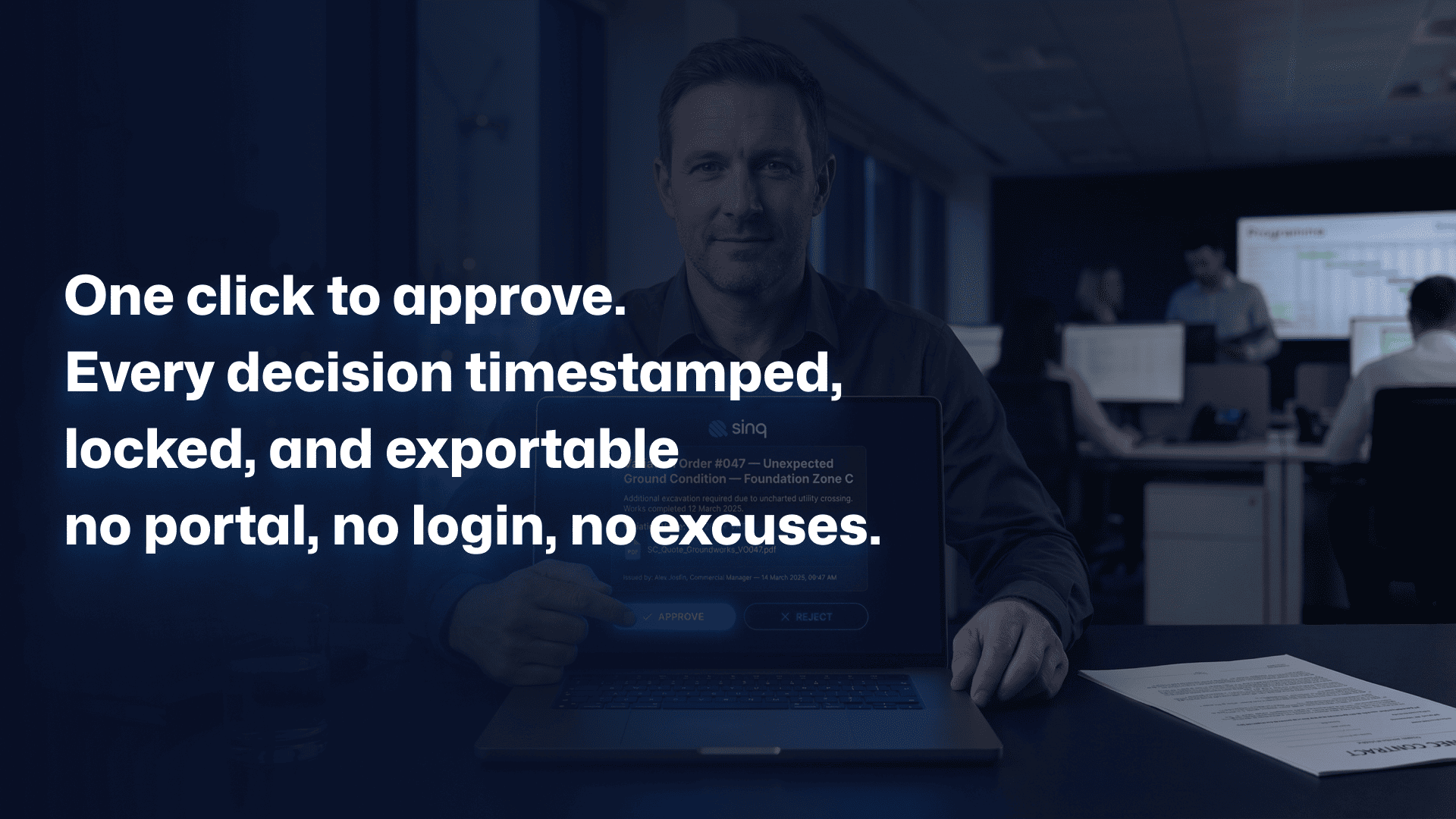
Sinq’s Variation Management Software uses structured client approval workflows to fix the weakest link in that chain. For every variation, Sinq sends the client a secure email link — no login, no portal. They click once to approve or reject.
Furthermore, Sinq logs their decision, timestamp, and any comments automatically against that variation the moment they respond.
Sinq’s audit trail logging then gives commercial teams a full history of every cost-related decision. Every change, approval, and rejection carries a record of who did what and when.
As a result, when a client questions a variation months later, the QS exports a full variation schedule in seconds with every timestamped approval attached and no room for dispute.
Real-world variation exposure: how Sinq’s financial impact visualisation turns hidden risk into live numbers
Most contractors handle variation exposure incorrectly because they treat variations as paperwork rather than live financial risk. A few unpriced mechanical and electrical changes, a late design tweak to finishes, and a couple of provisional sum adjustments that nobody tracks properly can destroy the margin on any size project before the problem becomes visible.
Those are not admin issues. They are early warning signs that design, scope, and client expectations are drifting from the original deal.
Sinq’s financial impact visualisation turns those warning signs into numbers commercial teams can act on. Sinq maps each variation against the original contract sum and current forecast the moment the team raises it.
Commercial teams see exactly how much margin each change consumes before approving it. Furthermore, high-risk, high-value variations stand out immediately so teams can prioritise approvals, challenge scope creep, or renegotiate before work proceeds.
As a result, variation exposure stops being a month-end surprise and becomes a daily, visible position that commercial directors can manage in real time.
How Sinq’s variation tools work together to predict commercial failure early with Construction Variation Approval Software
The frustration for commercial teams is not that variation tools do not exist. It is that they are scattered — one system for RFIs, another for quotes, another for approvals, and then Excel tying it all together badly.
Consequently, data does not match, versions drift, and commercial teams spend more time reconciling than managing risk.
The fix is a single variation spine that every cost-related decision connects to.
Sinq’s variation tracking does that job. Sinq logs every scope change, version-controls it, and updates it financially in one place. Commercial teams see who raised it, what changed, which subcontractor quote is attached, and where client approval sits — in real time.
That spine connects directly to quotation management, where subcontractor quotes upload as PDFs with zero manual data entry and Sinq links each quote directly to the right variation.
Furthermore, Sinq’s Construction Variation Approval Software closes the loop that construction change software most often misses. Most tools stop at logging the change but never tie in the money or the approval.
Sinq connects all three so every variation carries a clear cost, a confirmed source, and a binary approval status.
As a result, commercial teams stop chasing approvals across email chains and start managing variation risk from one connected financial platform.
Variation tracking software for builders and smaller main contractors with Variation Approval Software built in
Smaller and mid-size main contractors feel variation pain harder than anyone. Without a large commercial team to absorb the mess when variations run wild, one disputed final account can wipe out a year of profit.
A lot of Software for small contractors is either too basic to handle real variation complexity or so bloated it never gets used on site. Consequently, teams end up back with spreadsheets and WhatsApp — and the exposure builds silently again.
Sinq was built for UK main contractors who live in that middle ground. It mirrors standard UK commercial processes for valuations and variations so teams do not have to learn a new approach to use it.
Furthermore, Sinq’s Variation Approval Software means even lean commercial teams run disciplined, timestamped approvals without extra admin staff.
For builders who need variation tracking software for builders that fits their reality, Sinq provides:
- Supervisor mobile RFIs that Sinq converts into variations automatically
- Real-time cost exposure dashboards that show live financial risk as it builds
- Direct PDF and Excel exports for client reports and variation schedules in seconds
Using variation accounts as a commercial early warning system with Sinq’s Variation Order Software Construction workflow
The commercial skill is not just recording variations. It is reading the variation account like a risk dashboard.
When variation patterns spike — lots of verbal instructions, repeated late design changes, or constant provisional sum adjustments — that is the early warning signal that the job is drifting commercially.
Sinq turns variation accounts into a live early warning system by connecting its real-time cost exposure dashboard, variation tracking, and financial impact visualisation into one financial picture.
Commercial teams see patterns building week by week so they can escalate, renegotiate, or re-scope before the job fails commercially.
Furthermore, Sinq’s Variation Order Software Construction workflow means every escalation carries a timestamped record that protects the contractor’s position regardless of how the client responds.
Getting started with Sinq’s Construction Change Software without disrupting live projects
Commercial recovery usually starts too late because teams assume new software will be hard to roll out. Consequently, they delay, and another project slips commercially while they consider options.
Sinq drops into existing UK workflows without disrupting live projects. Commercial teams keep their valuation process and client reporting format and simply stop chasing variations across half a dozen disconnected systems.
Most teams start with three simple steps:
- Activate variation tracking for all new projects so Sinq captures every change from day one
- Roll out the supervisor mobile RFI system to site so issues reach commercial instantly without double entry
- Use direct PDF and Excel export to feed existing client reports and internal commercial reviews
As a result, within one valuation cycle most commercial teams see the shift — cleaner variation accounts, faster approvals, and a financial picture that survives client scrutiny at every valuation.
Why Variation Tracking Software must align with UK workflows to protect margin
A lot of construction software gets built generically and then pushed into UK contracting. That is where friction starts and adoption fails. If a tool does not reflect how UK valuations, variations, and approvals actually work, teams bypass it and return to email and Excel.
Sinq is built around UK construction commercial processes from the ground up. It mirrors standard UK workflows from valuation cycles to variation approvals so commercial managers and QSs work with the tool rather than against it.
Furthermore, because Sinq centralises real-time cost exposure, structured client approvals, and full audit trails into one financial platform, main contractors get earlier warning signals, tighter variation control, and stronger margins across every project they run.
Margin lost to untracked variations rarely comes back. Explore Sinq today and see how smarter variation management and live financial visibility protect your commercial position from first instruction to final account.