
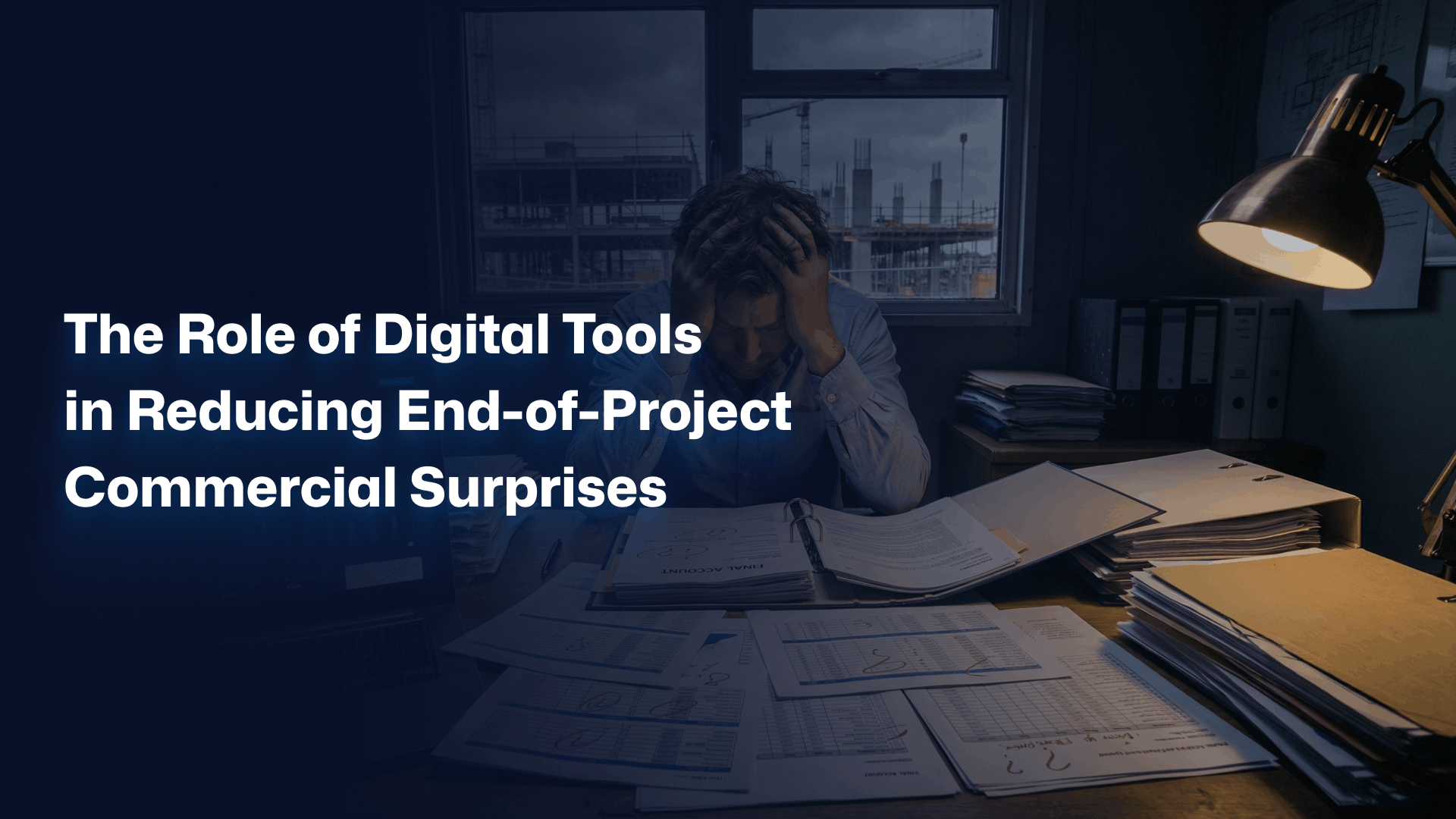
The project ran to programme. The team did good work. The monthly reports showed everything broadly on track. Then the final account came in £87,000 below where the commercial manager expected it to be, and the post-project review produced the explanation nobody wanted to hear: variations that were raised but never formally approved, instructions that were acted on but never documented as changes to the contract, and a variation register that reflected what the QS remembered rather than what the project actually generated.
This is the end-of-project commercial surprise that UK contractors consistently describe as one of the most damaging and least-preventable commercial risks they face. Damaging because the margin erosion is real and often significant. Least-preventable, they believe, because the project looked fine right up until it didn’t.
That belief is the most expensive misconception in construction commercial management. The final account surprise isn’t a sudden event. It is the accumulation of dozens of small process failures across the life of the project: variations captured too late, evidence assembled retrospectively, approvals obtained informally, and cost exposure tracked against a commercial model that was never updated in real time. The surprise isn’t at the end. It is built into the process from the start.
According to RICS analysis of UK construction commercial performance, final account disputes and margin erosion from variation management failures affect an estimated 65% of projects above £1 million in value. That isn’t a statistic about bad projects. It is a statistic about an industry running a commercial close-out process that was designed for a different era of construction.
Variation management software and construction variation software change this not by adding complexity to the commercial process but by making cost visibility a continuous feature of the project rather than a final account exercise. The rest of this article explains the mechanism precisely.
Why Final Account Surprises Are Built Into the Process, Not the Project
The most persistent misconception about commercial surprises at project close-out is that they result from specific events: a dispute with a difficult client, an unusually high volume of design changes, or a QS who wasn’t across the detail. These things happen. But they aren’t the primary driver of commercial surprises on UK construction projects.
The primary driver is structural: the way most contractors manage variations creates a systematic delay between when commercial exposure is created and when it becomes visible to the people responsible for managing it. The variation happens on site. It takes days or weeks to be formally raised. It takes further weeks to move through an approval process. The cost sits somewhere between the project record and the contract value without contributing to either until approval is obtained. The commercial manager reviews a monthly report that reflects certified amounts rather than total exposure. The gap between what’s been built and what’s been approved accumulates invisibly until final account, when it becomes undeniable and unsolvable simultaneously.
This is why UK contractors face commercial surprises at project close-out: not because anything went dramatically wrong, but because the information architecture of the project was never designed to surface cost exposure in real time. The commercial team was always managing with a six-to-eight-week information lag. By the time the lag resolved, the decisions that could have changed the outcome had already been made.
The best digital variation management tools for UK contractors are built specifically to close this lag: capturing variation cost at the point it is incurred rather than at the point it is approved, making the total exposure visible against contract value in real time, and giving the commercial team the information they need to manage the project’s commercial position rather than discover it.
Not a faster version of the existing process. A fundamentally different one.
The Variation Register That Nobody Trusts
Ask any experienced QS on a UK construction project whether they trust their variation register at any given point in the project. The honest ones will tell you the same thing: the register reflects the variations they know about, raised in the format they capture them, valued at the best estimate they had time to apply. It is not a complete picture of the project’s commercial exposure. It never has been.
This isn’t a criticism of QS capability. It is a description of how variation registers work when the information feeding them is informal, delayed, and incomplete. The site manager who raised a variation verbally last Tuesday and hasn’t had time to formalise it yet: that variation isn’t on the register. The subcontractor who submitted a variation application three weeks ago that the QS is still reviewing: the cost impact of that variation isn’t in the commercial model. The instruction issued by the client’s engineer that everyone on site treated as a variation but nobody raised formally because the project was already behind programme and the paperwork felt secondary: that exposure is invisible.
The register isn’t wrong. It is incomplete in a way that compounds over the life of the project and surfaces as a commercial surprise at the end.
Construction final account preparation software built for variation management solves this by changing where the register gets its information. Rather than relying on QSs to manually populate a tracker from memory and email chains, the platform captures variation information at the point it is created: the site manager raises a VRF from the mobile app on the day of instruction, the subcontractor submits their variation through the same system, the cost is allocated immediately, and the register updates in real time. The QS isn’t feeding the register. The project is feeding the register.
Consider what that means for the commercial manager’s monthly review. Rather than receiving a report that reflects what the QS had time to update last week, they open a dashboard showing every variation raised across every live project, current status, current cost exposure against contract value, and items flagged for attention because they’ve been in the approval queue longer than the defined threshold. The information is current because it is continuous.
That is the practical difference between variation cost visibility as a feature and variation cost visibility as a reality.
How Unapproved Variation Costs Distort the Commercial Picture
One of the subtler contributors to final account surprises is a problem that most commercial teams don’t formally track: the distinction between variations that have been raised and variations that have been approved, and what happens to the commercial picture when those two numbers diverge significantly.
On a project where the variation register is well-managed, the gap between raised and approved variation value at any given point should be relatively narrow: variations move through the approval cycle quickly, and the certified amount broadly reflects the total exposure. The commercial manager’s view of the project’s financial position is reasonably accurate.
On a project where the variation process is informal and the approval cycle is slow, the gap can be substantial. Variations worth £120,000 have been raised; variations worth £45,000 have been approved; the remaining £75,000 is sitting somewhere in the process without a formal status. The commercial model is being run against the £45,000. The project’s actual exposure is £120,000. The difference is invisible until someone forces the issue.
Picture a main contractor on a £3.5 million commercial fit-out project with forty-eight variations raised across a nine-month programme. Twenty-two of those variations, totalling £94,000, are in various stages of approval at any given point in the last third of the project. The monthly commercial report shows variation income of £156,000 the approved and certified amount. The total raised variation entitlement is £250,000. The commercial manager believes the project is marginally below the original margin target. The actual position, when the final account is eventually resolved, reveals a £94,000 entitlement gap that materialised because eleven of the unapproved variations couldn’t be substantiated with contemporaneous evidence after the site had been handed over.
How construction variation software prevents final account disputes is precisely this: by making the raised-versus-approved gap visible in real time rather than retrospectively, the commercial team can identify which variations are at risk of becoming unrecoverable before the evidence window closes rather than after.

The Cost of Running a Commercial Model on Stale Information
Reducing construction cost overruns in the UK requires accurate commercial information at the point decisions are made. Not in the monthly report. Not at the post-project review. At the moment the project team is deciding whether to proceed with additional work, how to price a subcontractor’s application, or whether to challenge the client’s QS on a specific variation.
The commercial model that most UK contractors run in practice is not a real-time model. It is a model that was accurate six to eight weeks ago, updated with whatever information made it into the last reporting cycle, and supplemented by the QS’s professional judgement on items that are too recent to have been formally processed. That model is good enough for most decisions most of the time. It is dangerously insufficient for the decisions that determine final account outcomes.
Consider the scenario of a project QS who is deciding whether to challenge a client’s variation assessment of £12,000 against an internal estimate of £21,000. To make that decision well, the QS needs to know the project’s current contingency position, the total unapproved variation exposure, the programme impact of the disputed variation, and the strength of the evidence record supporting the higher value. If any of those inputs are more than two weeks old, the decision is being made on incomplete information.
The best variation management software for UK contractor final accounts makes those inputs available in real time from a single screen rather than requiring the QS to query three different systems and make two phone calls before they have enough information to act. The decision quality improves not because the QS got better at their job but because the information infrastructure the job runs on got better.
Stale commercial information doesn’t just produce bad final accounts. It produces bad decisions throughout the project that lead to bad final accounts.
Digital Variation Management and the Final Account: A Different Starting Point
The contractors who consistently produce clean final accounts aren’t necessarily better at negotiating them. They’re better at preparing for them, and that preparation starts on the first day of the project rather than the last.
How digital tools reduce commercial surprises at the end of construction projects is fundamentally about starting point. A final account where every variation has been raised contemporaneously, evidenced with photographs and site records, approved through a documented chain, and tracked against contract value in real time starts from a position of strength: the contractor arrives at the final account meeting with a complete, structured variation register that reflects the full entitlement and can be supported by the evidence for every line item.
A final account where variations were raised informally, tracked through a spreadsheet that was last updated three weeks before practical completion, and evidenced with email threads and site diary entries starts from a position of negotiation: the contractor arrives with a claim that needs to be defended rather than a record that needs to be agreed.
The difference in outcome between those two starting positions is not marginal. In the first scenario, the conversation at final account is about how quickly the account can be agreed and the final payment released. In the second, it is about which variations the client will accept, which they will reduce, and which they will challenge outright. The contractor in the second scenario almost always walks away with less than their full entitlement, because the record doesn’t fully support it.
Construction commercial close-out tools built for variation management give contractors the first scenario rather than the second not through better commercial tactics at the end, but through better commercial process throughout.
Why Monthly Reports Are a Lagging Indicator of Commercial Health
The standard UK construction commercial reporting cycle reinforces the problem it’s meant to solve. Monthly progress reports, monthly cost reports, and monthly variation registers are produced at the end of each period and reviewed at the beginning of the next. By the time an issue appears in a monthly report, it has already been developing for three to four weeks. By the time the review meeting generates a response, five to six weeks have passed since the issue first arose.
For most project management decisions, a one-month information lag is manageable. For commercial decisions on variations, it is often fatal. A variation that is not raised withinthe contractual notification period loses its entitlement regardless of how strong the underlying claim is. A variation where the evidence window closes before contemporaneous records are captured becomes undefendable regardless of how clear the instruction was. A cost overrun that is identified in month six of an eight-month project is a different problem from one identified in month three.
Digital tools for construction commercial control shift the reporting model from lagging to leading. Rather than a monthly snapshot of what happened last period, the commercial team has a continuous view of what is happening now: which variations are in the approval queue, which have been outstanding for longer than acceptable, which projects are carrying unapproved cost exposure above the internal threshold, and where the programme impact of current variations is likely to create time-related cost exposure if it isn’t addressed.
Evaluate your current commercial reporting process against this standard. If you can’t answer the question “what is our total unapproved variation exposure across all live projects right now” without asking someone for a report, the reporting model is lagging. If the answer to that question requires a phone call to three separate QSs and a consolidation exercise that takes the better part of a day, the visibility problem is structural.
The Honest Concession: Digital Tools Don’t Eliminate Commercial Risk in Construction
No variation management platform eliminates the commercial risks that arise from contractual ambiguity, design changes that exceed any reasonable contingency, or a client who is determined to challenge entitlement regardless of the quality of the record.
There are projects where the commercial surprise isn’t a process failure. A contractor who wins a project on a fixed-price contract with a scope that changes fundamentally during delivery is carrying a commercial risk that no variation management system can fully absorb. A client organisation that is in financial difficulty and using variation disputes as a tool for deferring payment will find reasons to challenge variations regardless of how clean the documentation is.
The honest scope of what construction variation software provides is this: it closes the commercial gaps that arise from process failure rather than the ones that arise from contractual structure or client behaviour. For the majority of final account surprises on UK construction projects, process failure is the primary cause. The record was incomplete, the approval chain was unclear, the cost exposure was invisible, and the final account started from a negotiation rather than an agreement. Digital tools address all four of those failure modes directly.
For the minority of final account surprises that are genuinely structural the contract was wrong, the client is insolvent, the scope was fundamentally misrepresented no process improvement closes the gap. But these situations are rarer than the post-project review process tends to suggest. It is consistently more comfortable to attribute commercial underperformance to external factors than to acknowledge that the internal process failed to protect an entitlement that existed.
Building a Project Commercial Process That Produces No Surprises
The commercial teams that consistently close out projects without surprises have built processes that share three characteristics: they capture variation cost at the point it is incurred, they make total exposure visible in real time rather than reporting it periodically, and they maintain the evidence quality required to defend every line of the final account before the project reaches practical completion.
These characteristics don’t require large commercial teams or extensive administrative overhead. They require a platform that makes the right process the natural output of the normal workflow: a site manager raises a VRF on site with photographs when an instruction is issued; the variation moves through a defined approval chain; the cost is allocated to the project’s exposure dashboard immediately; the QS reviews outstanding approvals before each valuation deadline; and the commercial manager monitors the portfolio position from a single real-time view.
How to avoid budget overruns using construction variation software isn’t a question about better contingency planning or more conservative margin targets. It is a question about the quality of the commercial information the project team is working with throughout the project. When that information is current, complete, and accessible to the right people at the right time, the decisions that protect margin are made with enough lead time to be effective.
A UK-focused variation management software platform captures the variation record at the point of instruction, manages the approval workflow, tracks cost exposure in real time against contract value, and gives commercial leaders the portfolio visibility they need to manage proactively rather than reactively. From the mobile VRF raised on site to the real-time dashboard reviewed in the office, the entire variation lifecycle sits in one structured system.
The final account surprise that cost your last project £87,000 wasn’t inevitable. It was the predictable output of a process that wasn’t designed to prevent it
Frequently Asked Questions
How do digital tools reduce commercial surprises at the end of construction projects?
Commercial surprises at project close-out are almost always the result of accumulated process failures across the project lifecycle: variations captured late, evidence assembled retrospectively, cost exposure tracked against an incomplete register, and approval delays that remove entitlement from the certified amount. Digital variation management tools close these gaps by capturing variation cost at the point it is incurred, maintaining a real-time cost exposure dashboard, and managing the approval workflow through a structured process rather than informal communication. The result is a final account that starts from a complete, evidenced variation register rather than a retrospective reconstruction.
What is the best variation management software for UK contractors preparing final accounts?
The most effective platform for final account preparation is one that creates the final account record continuously throughout the project rather than requiring assembly at close-out. It should capture variations via a mobile tool at the point of instruction, route approvals through a formal workflow with a timestamped decision record, track unapproved variation exposure against contract value in real time, and provide portfolio-level visibility for commercial leadership. The ideal solution is built specifically for UK construction and focused exclusively on variation and commercial change management.
How does construction variation software prevent final account disputes?
By ensuring that every variation has a contemporaneous record: a timestamped instruction, a scope description, photographic evidence captured on site, a formal approval from an authorised party, and a cost assessed at the time of instruction rather than retrospectively. A variation with a complete contemporaneous record is significantly harder to dispute at final account than one assembled from email threads and memory. The dispute isn’t won at the final account meeting. It is prevented by the quality of the record created on the day the variation was instructed.
Why do UK contractors face commercial surprises at project close-out?
The primary cause is an information architecture that reports commercial performance retrospectively rather than in real time. Monthly cost reports reflect what happened last period. Variation registers reflect what the QS had time to update. The certified amount reflects what the client approved weeks ago. None of these provide the commercial team with a current, complete view of the project’s cost exposure. When the gap between the visible commercial position and the actual position is only resolved at final account, the surprise is the difference between those two numbers and it is almost always negative.
How do I avoid budget overruns using construction variation software?
Budget overruns on variations are most effectively prevented by making the total variation exposure visible against the contract value in real time, so that the commercial team can identify when exposure is approaching or exceeding the contingency budget with enough lead time to act. A platform that updates the cost exposure dashboard as variations are raised rather than when they are approved gives the commercial team an accurate picture of where the project is heading rather than where it has been. Early visibility enables early intervention. Late visibility enables post-project regret.
What are digital variation management tools for construction final account preparation?
These are platforms that manage the entire variation lifecycle from instruction to final account through a structured digital workflow: VRF raised on site with photographs via a mobile app, approval routed to the correct authority, cost tracked against contract value in real time, and a complete audit trail generated automatically. At final account, the output is a structured variation register with contemporaneous evidence for every line item rather than a retrospective assembly from email chains and spreadsheet entries. The practical effect is a final account that reflects the full variation entitlement with evidence to support every item.
Eliminate Final Account Surprises With Real-Time Variation Visibility
If your projects are discovering commercial exposure at final account rather than managing it throughout delivery, you’re running a commercial process that was designed for a different era of construction.
Real-time variation visibility isn’t an efficiency gain. It’s a fundamental change in how commercial teams operate. Instead of reviewing a variation register that reflects what the QS had time to update last week, you open a dashboard that shows every variation raised, current status, cost exposure against contract value, and items flagged for attention. Instead of discovering at final account that £87,000 of entitlement was lost because the record couldn’t support it, you identify those at-risk variations while the evidence window is still open and the entitlement can still be recovered.
A dedicated variation management platform captures variations at the point of instruction via mobile app with timestamped photographs. QSs approve within forty-eight hours. Cost exposure updates in real time. The commercial team manages proactively rather than reactively. The final account reflects full entitlement supported by complete evidence.
Start a free trial at https://sinq.co.uk/ to see how real-time variation visibility changes your final account outcomes. Run it on your most commercially exposed current project alongside your existing process for thirty days. Track the unapproved variation exposure, the approval cycle time, and the completeness of the evidence record.
The final account surprise you prevent in the first month will pay for the entire year.
Visit https://sinq.co.uk/ today. Final accounts without surprises aren’t luck. They’re built.