
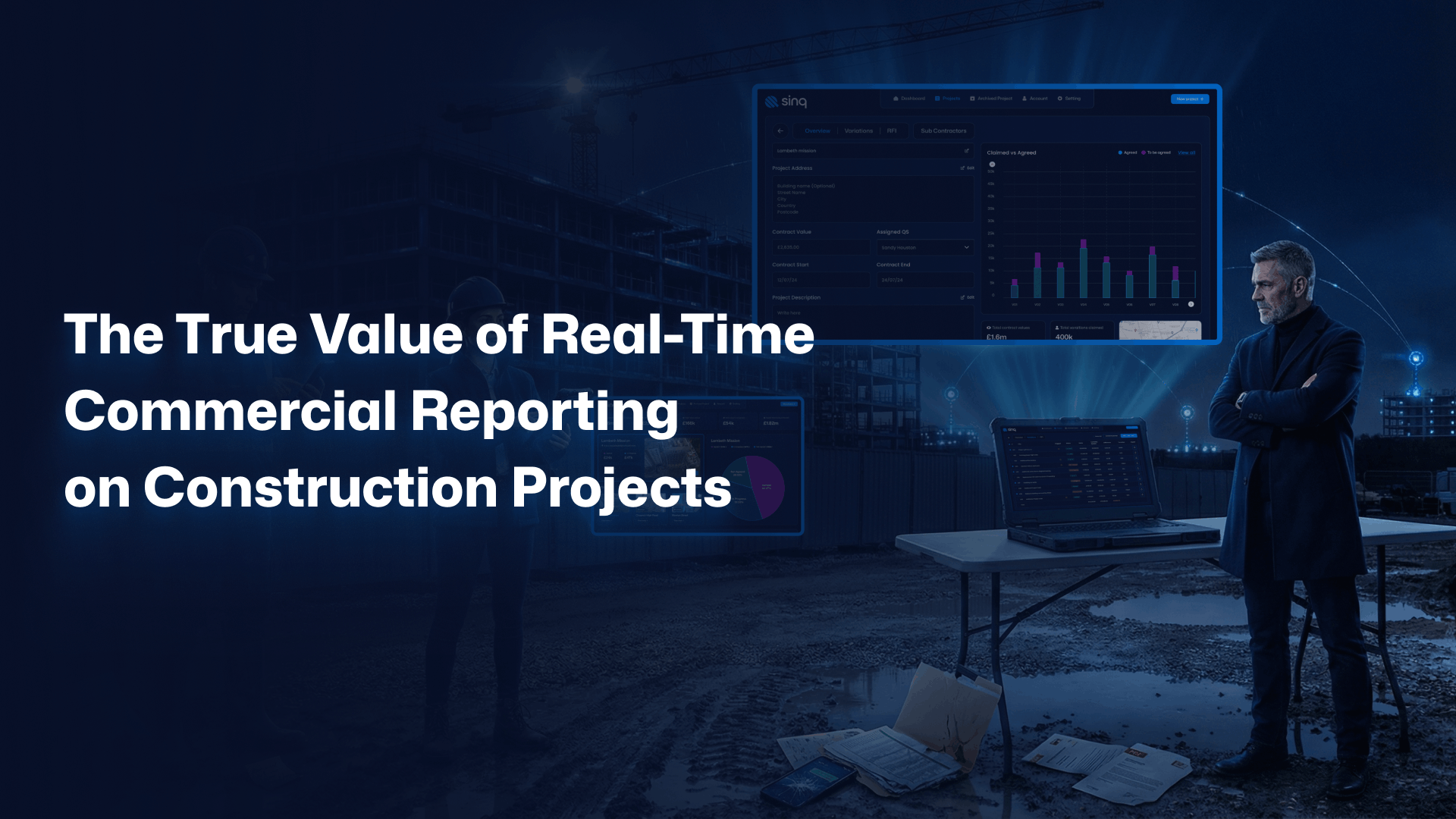
The final account meeting shouldn’t be the moment you discover money has been quietly bleeding out of your project.
Yet this happens on thousands of UK construction sites every month. A project manager sits across from a quantity surveyor and learns that pending variations worth £150,000 remain unapproved. Or worse, approved variations were never actually recorded in the system. Or the timeline on a critical change has shifted, but nobody documented the programme impact. By then, the project is already weeks past practical completion. The evidence is fragmented across email threads, marked-up drawings, and conversation notes that nobody can quite find.
This is the cost of fragmented variation management. Not the variations themselves. The fragmentation.
Real-time commercial reporting the ability to see live variation data, cumulative cost exposure, programme impacts, and approval status across your entire project, updated as changes happen transforms variation management from a defensive end-game exercise into an active financial control system. It tells you what’s actually being approved, what’s still pending, what it all costs together, and whether your project is still on track financially and schedule-wise.
The difference is the difference between fighting for margin at final account and protecting it before the problem ever starts.
Why Fragmented Variation Data Costs Projects Six Figures
Here’s what poor variation tracking actually looks like in motion: A subcontractor submits a variation request for additional groundworks. It goes to the site manager, who forwards it to the client’s representative, who passes it to the project manager, who emails it to the quantity surveyor. Three days pass. The QS reviews it, raises a query, sends it back. Five more days.
Meanwhile, the subcontractor is waiting for approval before pricing the work properly. The site manager, impatient for an answer, instructs the sub to proceed anyway “pending approval.” Work starts without formal agreement on cost or schedule impact.
The sub invoices for the variation, but it hasn’t been formally approved, so it gets flagged in the invoice query log. The invoice sits in accounts for weeks. The project runs over time because nobody formally assessed whether the variation would impact the critical path, so no extension of time is lodged. At final account, the variation cost sits somewhere between “approved but unpaid,” “done but not formally varied,” and “genuinely disputed.” Multiple this across 30 variations over an 18-month project.
Add in poor handover between team members who leave mid-project. Factor in multiple subcontractors, each running their own variation processes. Now add the cost of senior staff time spent forensically reconstructing what was and wasn’t approved, often during commercial close-out when they’re most stretched.
The real cost isn’t any single variation. It’s the cumulative friction of uncoordinated approvals, missed deadlines, and evidence that exists but can’t be found quickly.
The Financial Impact of Untracked Variations
UK contractors consistently report that untracked variations cost them between £50,000 and £250,000 per project, depending on contract value and complexity. That’s not hyperbole. That’s the difference between projects that run systematic variation processes and projects that treat them as an afterthought.
What separates projects that lose this money from projects that protect it isn’t heroic effort. It’s visibility. The moment a variation is created, the moment it’s approved, the moment it impacts the schedule all these things need to be visible to the right people at the right time. Not after the fact. Not during close-out. Now.
That’s what real-time commercial reporting actually does.
Start your free trial at sinq.co.uk to protect your project margin from day one.
The Hidden Cost of Waiting Until Final Account
A variation order isn’t complete when it’s signed. It’s complete when it’s formally approved by the client or contract administrator, priced and cost-controlled within the project budget, assessed for programme impact, documented with full audit trail and supporting evidence, integrated into progress claims or invoices, and resolved so both parties agree on cost and time.
Most UK projects fail at one of these steps. Many fail at multiple steps simultaneously.
The problem compounds because nobody realises it’s a problem until the final account stage. That’s when the project team attempts to reconcile all variations created over the project’s lifespan. By then, memories fade. People have moved to other projects. Email inboxes have been archived. The drawing that justified a change exists somewhere, but you’d need to reconstruct an entire conversation thread to prove it.
From that vantage point, variation management feels like archaeology. You’re excavating proof of decisions already made, work already done, costs already incurred. You’re trying to defend margin that you had six months ago but lost on the ground because of poor coordination.
The Reactive vs. Proactive Control Gap
What if you could see all of that in real time? What if you knew, on any given week, exactly how many variations were pending, what they would cost, what their combined schedule impact was, and whether they were stuck in approval because someone forgot about them?
The difference between reactive and proactive commercial control is knowing the answer before anyone needs to ask the question.
Real-Time Commercial Reporting: What It Actually Is
Real-time commercial reporting in construction means a single, live source of truth for every variation on a project, updated the moment changes happen.
Cost Exposure at Any Moment
Not “we have variations in flight.” Specifically: we have 12 pending variations totalling £347,000, of which £189,000 are waiting for client approval and £158,000 have been approved but not yet invoiced. You can see this in a dashboard. You can run it by trade, by subcontractor, by approval status, by cost range, or by creation date. You can ask: “What percentage of our contract value sits in unapproved variations?” The answer comes back in seconds.
Programme Impact Aggregated
Each variation is assessed for its effect on the critical path and float use. Real-time reporting tells you: “Approved variations have used 8 weeks of float. We have 6 weeks remaining before schedule impact becomes critical.” This isn’t guesswork. It’s a consolidated view of every variation’s time consequence, visible to the project manager, the site manager, and the client’s representative simultaneously.
Approval Workflow Visibility
You can see which variations are stuck where in the approval chain. The variation has been with the client’s representative for 11 days. The previous one took 3 days. This one is overdue. You can flag it, escalate it, or adjust site execution based on approval timing rather than waiting passively for an answer.
Audit Trail and Supporting Evidence in One Place
Every variation has a complete record: who requested it, when it was requested, what drawings or specifications justified it, what communication led to approval, what was actually approved, and by whom. When final account comes, you don’t reconstruct. You retrieve.
Subcontractor Variation Flow
Subcontractors can submit variations through a standardised channel. Upstream staff can see them aggregated. One-click escalation to the main contractor and client reduces the friction that currently happens across email and phone calls. A subcontractor’s variation isn’t stuck in someone’s inbox. It’s in a system.
Integration With Cost Controls
Approved variations automatically sync with the project budget and forecast. You don’t manually record a variation in a spreadsheet, then realise three weeks later that the budget hasn’t been updated. Every number in your project forecast reflects your current approved variations.
The net effect is that commercial exposure becomes visible, not at the end of the project, but as the project runs.
See how SINQ manages variations in real time visit sinq.co.uk.
Why Spreadsheets and Email Fail (Even With the Best Intentions)
Most UK contractors manage variations using some combination of email, spreadsheets, and shared drives. Someone creates a variation request form in Word or Excel. It gets emailed to the QS. The QS updates a separate spreadsheet with cost data. The programme manager gets a different email with schedule impact details. The client’s representative approves it via email reply. The site manager prints it out or screenshots it.
Three different records of the same variation now exist, often with conflicting information. When you need to audit what happened, you’re pulling from four different sources of truth. When you need to see cumulative exposure, you’re manually summing cells in a spreadsheet that hasn’t been updated in a week because the QS is on site. When a subcontractor asks “is my variation still pending?”, you’re scrolling through email threads from six months ago.
The problem isn’t laziness. Spreadsheets and email weren’t designed for collaborative, simultaneous, audit-tracked workflows.
They’re designed for static reporting and asynchronous communication. Construction variations need both real-time visibility and defensible documentation. Spreadsheets provide neither. Email creates a false sense of action something is happening, messages are being sent but no central visibility. A variation is “approved” because the client sent an email saying yes. But that email is in someone’s inbox. It’s not in the system. It’s not integrated with budget forecasts. It’s not linked to the corresponding programme impact. It exists in isolation.
Real-time commercial reporting systems don’t replace email entirely. They replace the use of email as a filing system. They give variations a home: a single platform where they’re created, reviewed, approved, documented, and automatically integrated into cost and schedule controls.
The friction drop is immediate. The financial impact compounds over time.
How Real-Time Variation Data Protects Margin
Consider a typical scenario: a main contractor on a £4.2m commercial build has a cost budget of £3.8m after preliminaries and overheads. Contingency is £180,000. The contract includes a 5% design contingency held by the architect.
Over the project’s first eight months, variations accumulate. Some are owner-requested scope changes. Some are design clarifications. Some are site-specific unforeseen conditions. The main contractor’s project manager has approved variations worth £127,000 so far, all within budget. But there are 16 pending variations totalling £94,000 awaiting client decision. If all are approved, the main contractor’s contingency drops to just £53,000 critically low with four months of construction remaining.
Traditional Approach vs. Real-Time Control
A traditional approach: the project manager knows this is probably happening, but hasn’t formally tallied pending variations against remaining contingency. The QS has a spreadsheet. The cost forecast was last updated two weeks ago. If a senior manager asks “what’s our realistic contingency position?”, the answer is educated guesswork.
A real-time reporting approach: the project manager opens a dashboard. It shows: £127,000 approved variations, £94,000 pending, £53,000 contingency remaining. It flags this as “critical” because remaining contingency has fallen below 2% of contract value a common threshold for risk tolerance. The project manager now makes an informed decision: do we escalate pending variations to the client for faster decisions, or do we tighten scope expectations, or do we proceed more cautiously with risk?
This isn’t heroic. It’s basic financial control. But it only works if you have current visibility of the numbers. Most UK projects don’t.
The margin protection compounds when you layer in programme impact. A variation that adds £15,000 in cost but uses six weeks of float is materially different from a variation that adds the same cost but uses only two days. Real-time reporting lets you see both the cost and the time consequence simultaneously, and assess whether the combined impact justifies the work.
Over a project’s lifetime, this kind of decision-making tightens cost control by 3-5% on average. For a £4m project, that’s £120,000-£200,000 in protected margin.
Subcontractor Variations: Why Communication Breaks Down
Here’s where fragmented variation management causes the most friction: in the subcontractor chain.
A mechanical services subcontractor encounters an unforeseen coordination issue. The ceiling zone planned for services conflicts with structural elements that were added during design development. The sub prepares a variation request, outlining the extra work needed and the cost impact. Then it gets sent to the main contractor’s site manager.
The site manager has forty other issues on his plate. The variation sits in his inbox. The sub follows up. The site manager forwards it to the project manager. It takes three days for the project manager to see it. Another two days to review and escalate to the client’s representative. The client needs time to evaluate whether the variation is genuinely necessary or whether the sub is asking for work they should absorb.
Meanwhile, the sub is waiting. They can’t schedule labour for work they can’t confirm will be approved. They can’t order materials without knowing the cost is committed. They can’t move their crew to another part of the site because they might need them here if approval comes through. The delay isn’t just inconvenient. It creates a scheduling cascade.
Work that depends on the service installation can’t start on time. The sub’s next job down the line is affected because their crew isn’t available as planned. Costs creep up because of idle time, rework, or expedited ordering. From the main contractor’s perspective, it looks like the sub is slow. From the sub’s perspective, it looks like they’re being held hostage by approval processes.
How Real-Time Systems Reduce Friction
A real-time variation system doesn’t eliminate this friction entirely. But it radically reduces it. A subcontractor can submit variations through a standardised channel not email to an overworked site manager, but a system. The site manager gets a notification. The project manager can see it immediately. The client’s representative can prioritise approval decisions based on schedule impact. If a variation is critical to the path forward, it gets escalated. If it can wait, the sub knows that and can plan accordingly.
This is why subcontractor management features matter so much in practice. They collapse communication chains that currently span days into workflows that can be handled in hours.
From Data to Action: Real Decisions Made With Real-Time Visibility
The abstract value of “real-time reporting” becomes concrete when you see how it actually changes decision-making on site.
A project manager on a 24-month mechanical plant overhaul is in a weekly cost meeting with the client’s QS. She pulls up her variations dashboard. It shows 18 approved variations totalling £287,000, 8 pending variations totalling £156,000, current budget utilisation at 94%, remaining contingency of £89,000, and projected final cost (based on pending variations approved at 70% likelihood) of £4.13m against a £4.1m budget.
This conversation doesn’t happen through email summaries. It happens in real time, with both parties looking at the same numbers simultaneously. The client’s QS immediately understands the position: contingency is thin, pending variations need expedited decisions, and the project is tracking toward a modest overrun unless something changes.
The conversation pivots. Instead of “here’s what’s happened so far,” it becomes “here’s what we need to decide.” The client’s design team needs to make a choice: approve the priority variations that sit in the pending queue, or adjust scope. The QS can see exactly which variations are time-critical (affecting the schedule) versus which are nice-to-have. That prioritisation wouldn’t be possible without aggregated real-time data.
By the next week, decisions have been made faster because the data was clear and current. Two variations were approved. One was deferred to final account phase. One was rejected with a rationale. The project’s cost forecast is now updated, accurate, and integrated into the financial forecast. The project manager can confirm: we’re still in budget, provided no major surprises emerge.
This is the difference between fighting for margin at final account and protecting it during execution.
Building the Audit Trail That Protects You
Real-time variation systems aren’t just useful for current visibility. They’re essential for disputes.
Construction variations are the number one source of contractual disputes on UK projects. Not because variations themselves are inherently contentious, but because the evidence of approval or lack thereof becomes fragmented and disputed. Did the client actually approve this variation? The sub says yes. Their email says yes. But the email went to an intermediate project manager who left the company six months ago. It was never formally recorded as approved in the contract administrator’s letter. Now, at final account, both parties have different versions of what was approved and when.
A real-time variation system creates an immutable record. When a variation is created, the system records who created it, when, and what it specified. When it’s submitted for approval, the system records the submission time and to whom. When it’s approved, the system records the approver, the approval time, any conditions, and any linked documentation. If an approval is later disputed, you can produce a complete audit trail: screenshot timestamps, email confirmations, change history.
This matters intensely under UK law. Under the Security of Payment Acts and standard RICS/CIOB guidance, variations must be properly documented and communicated. A variation that was genuinely approved but poorly documented can be harder to defend legally than a variation that wasn’t done at all. Real-time systems eliminate this gap. You have proof because the system creates it automatically.
For subcontractors and suppliers, this is equally important. A supplier invoices for a variation. The invoice is queried because the variation wasn’t formally approved in the system. The supplier can’t produce evidence quickly. The invoice sits unpaid for weeks. Meanwhile, the supplier’s cash flow suffers. With real-time variation systems, the moment a variation is approved, it appears in the system, and it can be matched to invoices automatically. Disputes drop because the proof is immediate and central.
The Real-Time Advantage Compounds Over Project Stages
Early project phases are where real-time variation visibility creates the most dramatic impact.
During the detailed design and early trades phase, variations are coming in regularly as design is finalised and site conditions become clear. A real-time system lets you catch cost and schedule exposure early, when decisions can still be made strategically. You can ask: “If all pending variations are approved, do we still have buffer in the critical path?” If the answer is no, you have time to request acceleration elsewhere or negotiate a schedule extension before it becomes a crisis.
Mid-project, real-time visibility helps with cashflow forecasting. You can predict, with reasonable accuracy, what your cumulative project cost will be based on current variations and typical approval rates. You can communicate this to your client confidently, rather than guessing and then surprising them at final account.
In the final phases and close-out, real-time data means less archaeology. The audit trail exists. Approvals are documented. The final account shouldn’t involve months of forensic reconstruction. It should be reconciliation of what the system already shows.
Across all phases, real-time commercial reporting means your finance team doesn’t spend hours every month manually updating forecasts based on information that’s days out of date. The system does that automatically.
Implementation: What Changes When You Move to Real-Time
Moving from fragmented variation management to real-time commercial reporting doesn’t require abandoning everything currently in place. It requires consolidation.
Instead of variations scattered across email, spreadsheets, and site conversations, they move to a single platform. Subcontractors submit through the system, not email. Approvals are recorded in the system. Cost and schedule data are linked, not maintained separately. Mobile access means the site manager can see and escalate variations from the site, not back in the office.
This creates a change in how variation workflows operate. Currently, someone creates a variation in Word, emails it, follows up verbally, emails again, and eventually a spreadsheet gets updated weeks later. With real-time systems, a variation is created once, submitted, and automatically visible to the right stakeholders. Approval workflows are clear: who needs to approve, in what sequence, by when.
For the quantity surveyor, the biggest change is that variation data is automatically integrated into cost forecasts. They don’t spend time manually updating the budget spreadsheet. They review the system’s aggregation and adjust as needed.
For the project manager, real-time variation dashboards become their primary cost control tool. Instead of hunting for current data, they have it on demand. Escalation decisions (which variations are critical, which can wait) are faster and more informed.
For subcontractors, the benefit is transparency and speed. They can see where their variation sits in the approval chain. They’re not waiting for someone to find an email and forward it. They know the status because it’s visible in the system.
The change management curve is real for the first 2-3 weeks, using a new system feels slower than email because the discipline of formal submission and documented approval isn’t habitual yet. But after that period, the compound savings in time and risk clarity become obvious.
Why This Matters Now More Than Ever
UK construction is under pressure. Margins are tighter. Client expectations for transparency are higher. Regulation around payment terms, contract communication, and audit trails is stricter.
A project that manages variations reactively discovering cost and schedule exposure at final account is a project that’s being run on luck. The next variation that hits with £80,000 in cost and four weeks of time impact could be the one that breaks the margin.
Real-time commercial reporting isn’t a nice-to-have improvement. It’s the baseline for professional project financial control in an environment where margins are thin and disputes are expensive. The contractors who are protecting margin and delivering on schedule are the ones who know, on any given week, exactly what their variation position is. They know what’s approved, what’s pending, what it costs, and what the time impact is. They make decisions quickly because the data is current. They communicate confidently to clients because they’re not guessing.
That visibility isn’t luxury. It’s how variation management actually works when done right.
The question isn’t whether your project needs real-time commercial reporting. It’s how long you can afford not to have it.
Frequently Asked Questions
What is variation tracking software in construction?
Variation tracking software is a digital platform that captures, records, and manages all changes to a construction project’s scope, budget, and schedule in one centralised location. Unlike email and spreadsheet-based systems, variation tracking software automatically records who requested each change, when it was requested, what approvals were given, and how it impacts cost and time. UK contractors use variation tracking software to replace fragmented email chains and manual spreadsheets with a single source of truth that integrates variations into live project budgets and forecasts.
How does real-time commercial reporting help contractors?
Real-time commercial reporting gives project managers and QSs instant visibility of every variation on the project, including cost exposure, approval status, and programme impact. Instead of manually updating spreadsheets days after changes happen, real-time systems show live data how many variations are pending, how much they cost, whether they’re stuck in approval, and whether they affect the critical path. This visibility means contractors can make informed decisions about which variations to prioritise, escalate faster approvals when needed, and protect margin before it erodes.
What is the best variation management software for UK contractors?
The best variation management software for UK contractors is built specifically for UK contract types (NEC, JCT, FIDIC) and workflows, includes mobile access so site teams can submit variations instantly, provides real-time cost and schedule dashboards, integrates with budget and cashflow forecasting tools, includes subcontractor variation management so subs can submit without email friction, and creates immutable audit trails for dispute protection. It should automate variation workflows so approvals move through the system quickly rather than languishing in email inboxes.
How do variation orders affect construction project budgets?
Variation orders directly impact project budgets by adding cost (or occasionally reducing it), consuming contingency, and shifting how other budget line items are allocated. Real-time commercial reporting shows exactly how approved and pending variations affect remaining contingency and project forecast. A project with £180,000 contingency might discover that pending variations (if approved) would reduce contingency to only £53,000 a critical warning that requires faster client decisions or scope tightening. Without visibility, contractors discover budget impact too late, during final account, when options to mitigate are gone.
Can variation software help reduce construction disputes?
Yes. Variation software reduces disputes by creating immutable records of when variations were created, who requested them, what approvals were given, and by whom. Under UK law (Security of Payment Acts, RICS/CIOB guidance), variations must be properly documented and communicated. A variation approved verbally but never recorded in writing is harder to defend in dispute than one recorded with full audit trail showing approval time, approver identity, and supporting documentation. Real-time systems eliminate the “he said, she said” arguments by creating proof automatically.
What does variation management software do for subcontractors?
Variation management software gives subcontractors a transparent, direct channel to submit variations rather than relying on site managers or project managers to forward requests. Subcontractors can see where their variation sits in the approval chain, whether it’s been approved, and what the cost and time impacts are. This transparency eliminates the frustration of waiting in limbo for approval decisions. When variations are approved, they immediately appear in the system and can be matched to invoices automatically, speeding payment rather than leaving invoices disputed and unpaid for weeks.
Get Started With Real-Time Variation Control
If your project is still managing variations through email and spreadsheets, you’re leaving money on the table every month. You’re creating disputes where clarity could exist. You’re making decisions without current information.
Real-time variation management starts with a platform built specifically for construction variation workflows. One that centralises variation creation, approval, cost tracking, and audit trails. One that integrates with your existing systems and doesn’t require wholesale process change.
Start your free trial at sinq.co.uk to see how real-time commercial reporting works in practice. See variations from day one. Track cumulative cost exposure. Manage subcontractor variations without email friction. Build the audit trail that protects you.
Your next project doesn’t have to discover variation issues at final account. It can manage them in real time.
Visit https://sinq.co.uk/ to protect your project margin from day one.
Control margin from the start.